Hasmonean Wall, Jerusalem

~164 BCE

Shabbat Miketz (מִקֵּץ – At the End), Rosh Chodesh Tevet, Hanukkah
Genesis 41:1–44:17 – Numbers 28:9–15 – Numbers 7:1–8:4 – Isaiah 66:1, 24 – Zechariah 2:14–4:7

In the first Sefer, Joseph interprets Pharaoh’s dreams and becomes viceroy of Egypt. Through his wisdom, he organizes grain reserves to face the coming famine. His brothers go down to Egypt to buy food, and Joseph tests them by demanding Benjamin’s presence.
In the second Sefer, the Torah describes the special sacrifices for Shabbat and Rosh Chodesh, marking the renewal of the lunar cycle.
In the third Sefer, the reading focuses on the offerings of the tribal leaders[1] during the inauguration of the Mishkan.
The Hanukkah Haftarah, taken from the prophet Zechariah, presents the vision of the golden Menorah fed by two olive trees and reminds us that deliverance will come “not by might, nor by power, but by My spirit.”

Zechariah 2:14
רָנִּי וְשִׂמְחִי, בַּת-צִיּוֹן–כִּי הִנְנִי-בָא וְשָׁכַנְתִּי בְתוֹכֵךְ, נְאֻם-ה’.
Rejoice and be glad, daughter of Zion! For behold, I am coming to dwell in your midst, says the Lord.

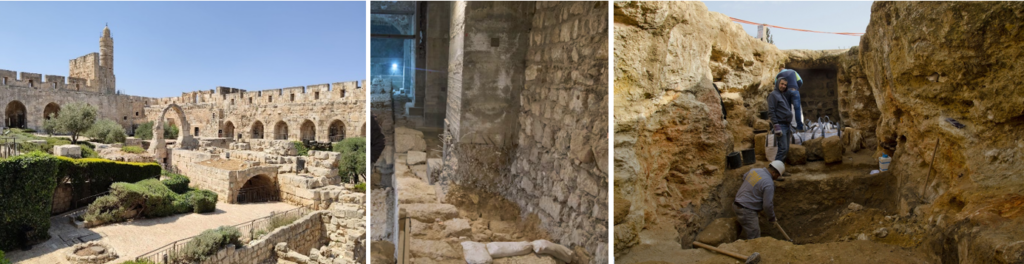
The Hasmonean walls[2] discovered in recent days are tangible witnesses of Jewish presence in Jerusalem during the Second Temple period. Located near the Tower of David, within the Kishle complex[3], this imposing fortification—accompanied by arrowheads, lead bullets, and catapult stones—attests to the fierce battles[4] of the Maccabean revolt against the Greeks, the founding event of Hanukkah.
These walls recall the resilience and permanence of the Jewish people in Jerusalem. This archaeological discovery, announced recently, is not merely a testimony of the past: it sheds light on our present by reaffirming the unbreakable bond between Jerusalem and the Jewish people.

[1] This Shabbat corresponds to the 6th day of Hanukkah: the reading mentions the offering of the tribe of Gad (Numbers 7:42).
[2] This section of the wall measures about 50 meters long and 5 meters wide. It is considered part of the foundations of a larger wall system that surrounded ancient Jerusalem and included 60 watchtowers over 10 meters high.
[3] The Kishle, meaning “barracks” (kışla in Turkish), is an Ottoman structure built around 1834 by Ibrahim Pasha as a military barracks. Converted into a prison and police station under the Ottoman Empire (1841), it is now part of the Tower of David Museum. This site reveals unique historical layers: remains of Hezekiah’s wall, Hasmonean fortifications, and traces of Herod’s palace, offering a journey through three millennia of history.
[4] Maccabean revolt: 2,189 years ago, on 25 Kislev 3597 (164 BCE), marking the dedication of the Temple and the origin of the Hanukkah festival.

Qmejja, mahJ, Paris

Vayéchev (וישב – “And he settled”)
Genesis 37:1 – 40:23, Amos 2:6 – 3:8

Yaakov favored his son Yosef and gave him a ketonet passim[1], a sign of distinction that aroused the jealousy of his brothers. Yosef’s dreams, foretelling his future rule over them, further fueled their anger; they sold him to merchants on their way to Egypt.
The narrative is interrupted by the story of Yehudah and Tamar: Yehudah refused to give his youngest son[2] in marriage to Tamar, but she devised a stratagem to obtain justice. From this union were born Peretz and Zerach, ancestors of the messianic lineage.
The haftarah from Amos denounces social injustice and reminds us that faithfulness to the divine covenant requires honesty and integrity.

Genesis 37:3
וְעָשָׂה לוֹ, כְּתֹנֶת פַּסִּים.
And he made him a multicolored tunic.

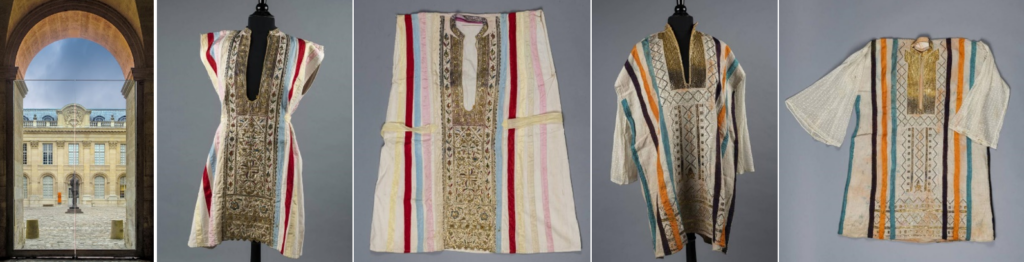
At the Museum of Jewish Art and History (mahJ, Paris), one can admire a multicolored Sephardic tunic[3] originating from Nabeul, Tunisia. This piece is a remarkable example of traditional Jewish textile. Made of cotton and linen, it is decorated with diagonal bands of colorful silk ribbons and a chest panel embroidered with floral motifs in multicolored threads, enhanced with gilded metal plaques. Measuring 92 cm in height and 53 cm in width, it was worn during the henna ceremony preceding marriage. Its rich palette and delicate craftsmanship recall Joseph’s multicolored tunic.

[1] The term Passim (פַּסִּים) appears in Genesis 37:3, 23, 32 (Joseph’s tunic) and 2 Samuel 13:18–19 (Tamar’s tunic). Its meaning is debated: multicolored or variegated; long down to the extremities (rabbinic interpretation); or a princely, luxurious garment reserved for royal daughters (cf. Tamar, daughter of King David).
[2] Levirate marriage (yibbum, יבום) is a biblical prescription: if a man dies without offspring, his brother must marry the widow to perpetuate his name. Mentioned in Genesis 38:7–8 (Tamar and Onan) and formally in Deuteronomy 25:5–10.
[3] The qmejja is a traditional Tunisian wedding tunic, richly embroidered and often multicolored, worn during marriage ceremonies. It is related to the Arabic word qamîṣ (shirt).

Marc Chagall Museum, Nice

~1963 / 1973

Vayishlaḥ (וישלח – “And he sent”)
Bereshit / Genesis 32:4–36:43 – Obadiah 1:1–21 (Sephardic) & Hoshea / Hosea 11:7–12:12 (Ashkenazic)

The parasha Vayishlaḥ recounts Ya‘aqov’s return to the Holy Land after twenty years in the house of Lavan. The messengers sent to ‘Esav return with troubling news: ‘Esav is coming to meet him with 400 men. Fearing confrontation, Ya‘aqov divides his camp, prays, and sends gifts. At night, he wrestles with a mysterious being who wounds him but blesses him, giving him the name Israel. The reunion with ‘Esav ultimately unfolds peacefully, each brother going his own way.

At Shekhem, the abduction of Dinah leads to the massacre of the inhabitants by Shim‘on and Levi, forcing Ya‘aqov to leave the city in haste. At Beit-El, God confirms his new name; on the road to Efrat, Raḥel dies giving birth to Binyamin; Yitzḥaq passes away in Ḥevron, where he is buried by his sons. The genealogy of ‘Esav is then established.

The Sephardic haftara from Obadiah announces the downfall of Edom, descendant of ‘Esav, and Israel’s ultimate victory, while the Ashkenazic haftara from Hosea recalls Ya‘aqov’s struggle with the angel and calls Israel to return to God.

Bereshit / Genesis 32:27
וַיֹּאמֶר לֹא אֲשַׁלֵּחֲךָ, כִּי אִם-בֵּרַכְתָּנִי
And he said, “I will not let you go, unless you bless me.”

In the central hall of the Marc Chagall National Museum [1] in Nice, the cycle The Biblical Message [2] is displayed. Among the twelve monumental canvases, Jacob Wrestling with the Angel illustrates the narrative of Genesis chapter 32 (verses 25–33). The blues and violets convey the inner intensity of the struggle, the diagonals of the bodies express dramatic tension, and the angel’s gesture touching Ya‘aqov’s forehead evokes both combat and blessing.

On the right edge of the painting appear: Ya‘aqov and Raḥel meeting at the well (love and divine providence, Genesis 29:1–12); Yosef stripped by his brothers and cast into a pit (jealousy, Genesis 37:23–24); and below, Ya‘aqov weeping over Yosef’s tunic (grief, Genesis 37:31–35). In the background, Chagall inserts elements of his personal universe, notably his native village of Vitebsk, thus intertwining his individual memory with that of the Jewish people.

The museum was inaugurated in 1973, at the initiative of André Malraux [3] and with the participation of Marc Chagall. It was the first national museum dedicated to a living artist, and today houses nearly one thousand works, combining paintings, stained glass, and mosaics in a space conceived by Chagall himself.

[1] Marc Chagall (1887–1985) actively contributed to the design of the museum, adding stained glass, mosaics, and an auditorium, and was present at the inauguration in 1973.
[2] The twelve monumental canvases of The Biblical Message include: Abraham and the Three Angels and The Sacrifice of Yitzḥaq (linked to parasha Vayera); Ya‘aqov and the Angel (linked to Vayishlaḥ); Moshe and the Burning Bush (linked to Shemot); The Crossing of the Red Sea (linked to Beshalach); Moshe Receiving the Tablets of the Law (linked to Yitro); The Prophet Yirmiyahu (Jeremiah) (read in the haftarot of the “Three Weeks” around Tisha Be-Av); David and Bat-Sheva (from II Samuel); King David and His Harp (inspired by Psalms); Eliyahu (Elijah) Taken Up to Heaven (from II Kings); and finally two canvases devoted to Shir HaShirim (Song of Songs), traditionally read on Shabbat.
[3] André Malraux (1901–1976), Minister of Culture, encouraged the creation of the museum and supported the donation of the Biblical Message cycle to the French State.