Kaifeng – China

Bo (בא – Va)
Exodus 10:1–13:16 • Jeremiah 46:13–28

The last plagues strike Egypt, and Israel prepares for deliverance.
Jeremiah announces judgment on proud nations and affirms the promise of restoration for Israel.

Exodus 10:1–2
וַיֹּאמֶר ה’ אֶל-מֹשֶׁה, בֹּא אֶל-פַּרְעֹה …
The Lord said to Moses: “Go to Pharaoh…”
וּלְמַעַן תְּסַפֵּר בְּאָזְנֵי בִנְךָ וּבֶן-בִּנְךָ …
“…so that you may tell your son and your grandson…”

The Jewish community (Tiāo jīn jiào, “those who remove the sinew”) of Kaifeng (Kāi-Fēng, “open – seal,” evoking the idea of a gate or passage) left manuscripts of exceptional value. Among these treasures is a 17th-century copy of the Torah portion Bo (1) 🔗, preserved at the Museum of the Bible in Washington. Other objects and documents are housed in several international museums, notably at the Bridwell Library (5) 🔗 in Dallas.

Attested[1] during the Song dynasty (960–1279), a period of great economic and cultural prosperity, the Jewish community of Kaifeng—then the imperial capital—developed. It later benefited from the protection of the Mongol Yuan rulers (1271–1368), known for their religious tolerance and openness to foreign populations. Under the Ming dynasty (1368–1644), an era of political stability and artistic and commercial growth, it reached its golden age. It eventually declined under the Qing dynasty (1644–1911), the last imperial dynasty, whose increased centralization and suspicion of foreign influences contributed to its weakening.

In the 19th century, the Taiping Rebellion[2] devastated the region. The synagogue was destroyed—location (1) and scale model at the Museum of the Jewish People (4) in Tel Aviv—and the last rabbi died, leading to the disappearance of organized communal life.

Seven clans[3], whose names are inscribed on synagogue steles (2), still claim Jewish ancestry today and strive to preserve the memory of this unique community.

[1] Jewish presence in Kaifeng is directly attested only from the Song dynasty, notably through synagogue steles (2). Some historians, however, consider an earlier arrival possible, given Kaifeng’s role as a commercial crossroads since the Tang dynasty (618–907) and the likelihood that Radhanites—Jewish merchants active along the Silk Roads—may have reached China before this period. Oral traditions of the community trace their origin to the time of the First Temple (586 BCE).
[2] Taiping Rebellion (1850–1864): one of the deadliest in history, with about 30 million deaths. Led by Hong Xiuquan, the Tàipíng Tiānguó movement (Heavenly Kingdom of Great Peace) advocated the establishment of a messianic kingdom. The rebellion profoundly destabilized the Qing dynasty and ravaged vast regions of central China, including Kaifeng, contributing to the disappearance of the last Jewish communal structures.
[3] The seven Jewish clans of Kaifeng: Ai (艾), Shi (石), Gao (高), Jin (金), Li (李), Zhao (趙), and Zhou (周).

Great Synagogue of Brussels

1878

Vaera (וארא – “And I appeared”)
Exodus 6:2–9:35 • Ezekiel 28:25–29:21

The first seven plagues strike Egypt, yet Pharaoh remains obstinate. God reaffirms His promise: to free His people and elevate them to an eternal covenant. Ezekiel prophesies the restoration of Israel, the downfall of nations, and divine sovereignty.

Ezekiel 28:26
וְיָשְׁבוּ עָלֶיהָ לָבֶטַח, וּבָנוּ בָתִּים, וְנָטְעוּ כְרָמִים; וְיָשְׁבוּ לָבֶטַח, בַּעֲשׂוֹתִי שְׁפָטִים בְּכָל-הַשְּׁאֵטִים אוֹתָם מִסָּבִיב, וְיָדְעוּ כִּי-אֲנִי ה׳ אלקיהם
.
They shall dwell securely, build houses, and plant vineyards; they shall live in safety when I execute judgments upon all those who despise them around them, and they shall know that I am the Lord, their God.

In recent years, the Belgian Jewish community has faced a surge in antisemitic acts [1], growing Islamist radicalization [2], geopolitical tensions [3], and increasing insecurity [4].

Although located in the historic and prestigious Sablons district, within the Great Synagogue of Brussels, the Central Jewish Consistory of Belgium has had to heighten its vigilance and strengthen security measures.

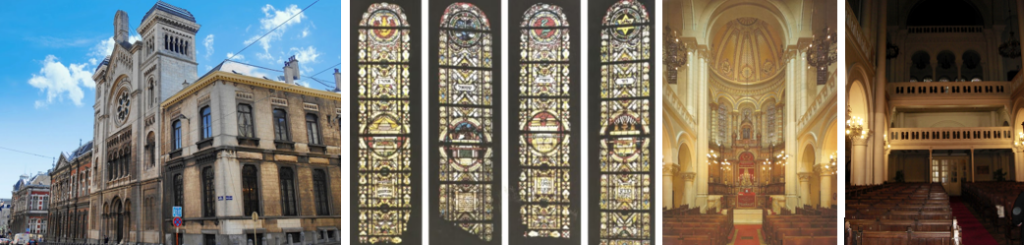
Listed as a heritage site by the Brussels-Capital Region since 1985, the synagogue, inaugurated in 1878, was designed by architect Désiré De Keyser. Built in Neo-Romanesque style with Neo-Byzantine influences, its imposing façade, adorned with round arches and oriental motifs, exemplifies 19th-century monumental art. Inside, the nave is bathed in the light of stained-glass windows created by Henri Dobbelaere. Above the hekhal, four stained-glass panels depict: Moché (staff and serpent, Exodus 7:9), Aaron (censer, Numbers 16:17), Samuel (balance, 1 Samuel 2:3) and David (star, a messianic and identity symbol).

[1] In 2018, during a televised interview on RTBF, Redouane Ahrouch, a Belgian municipal councillor and member of the Islam party, advocated for an Islamic state governed by Sharia law in Belgium.
[2] Rise in antisemitic acts: 277 incidents reported in 2024 compared to 59 in 2023; 68 incidents recorded between July and September 2025. Source: antisemitisme.be, October 2025.
[3] Geopolitical tensions: After October 7, 2023, polarization and importation of the Israeli-Palestinian conflict into Belgium. The CCOJB (Wallonia: Coordination Committee of Jewish Organizations of Belgium) and the FJO (Flanders: Forum der Joodse Organisaties) expressed deep concern (June 10, 2025).
[4] Sense of insecurity: According to the EU Fundamental Rights Agency survey published in July 2024, 83% of Belgian Jews believe antisemitism has worsened over the past five years, and nearly half are considering leaving the country. Furthermore, 70% avoid wearing religious symbols in public, and 54% avoid certain places for fear of assault.

Bet-El Synagogue – Caracas, Venezuela

1970

Shemot (שמות – Names)
Exodus 1:1 – 6:1 • Isaiah 27:6–28:13 and 29:22–23 (Ashkenazi) • Jeremiah 1:1–2:3 (Sephardi)

This parasha opens the cycle of deliverance. Saved by Pharaoh’s daughter, Moses grows up in the palace, flees to the Midianites, and then, at the burning bush, receives from God the mission to free Israel. The haftarah read by Ashkenazim emphasizes divine deliverance (27:8 / Exodus 14), while that of the Sephardim recalls God’s call commissioning the prophet Jeremiah (1:4‑8 / Exodus 3:12).

Exodus 3:2
וְהִנֵּה הַסְּנֶה בֹּעֵר בָּאֵשׁ, וְהַסְּנֶה, אֵינֶנּוּ אֻכָּל.
The bush was burning with fire, but the bush was not consumed.

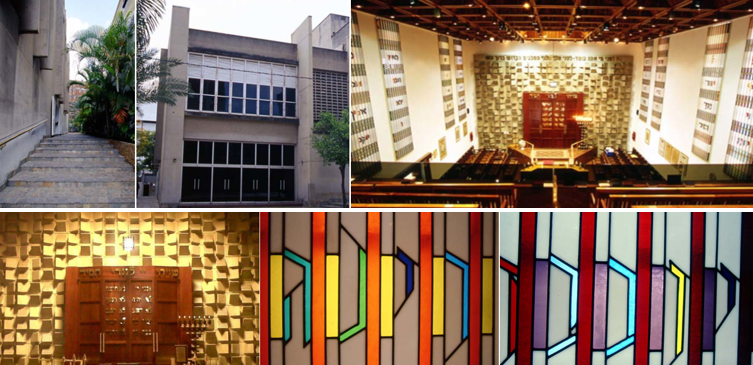
Built in the 1970s in a minimalist style, the Bet-El Synagogue of Caracas opens onto a vast prayer hall. At the back, the Heichal, sculpted by Venezuelan artist Harry Abend[1], captures and reflects light, evoking the divine presence of the burning bush. The kinetic stained glass by Yaacov Agam[2], integrated into panels and side openings, brings color and movement. The architectural ensemble came to life thanks to the support of philanthropist Edmond J. Safra[3].

Jewish presence in Venezuela dates back to the 17th century with crypto-Jews from Spain and Portugal. In the 19th century, families from the Caribbean settled there, and in the 20th century, the country welcomed Jews from Europe, the Middle East, and North Africa. By the late 1990s, the Jewish community numbered about 22,000 members.

The year 1999 marked the rise to power of Hugo Chávez. His strategic rapprochement with Iran and the diplomatic break with the State of Israel created an atmosphere of concern for the Venezuelan Jewish community. In 2013, Nicolás Maduro succeeded him. He strengthened these partnerships with Tehran and gave carte blanche to Hezbollah, involved in terrorist and criminal activities. The country sank into a deep crisis, and the Jewish community fell below 6,000 members. In January 2026, Nicolás Maduro was captured[4] by U.S. forces.

[1] Harry Abend (1937–2021), Venezuelan sculptor, Jew of Polish origin, winner of the Venezuelan National Sculpture Prize for his work “Forma” (1961).
[2] Yaacov Agam (born 1928) is an Israeli artist, a major figure in kinetic art. He created the Dizengoff Fountain in Tel Aviv, inaugurated in 1986. At 97, he received the Israel Prize for the year 5786 in the field of visual arts (painting, sculpture, and photography).
[3] Edmond J. Safra (1932–1999), Sephardic banker and philanthropist, born in Beirut to a Jewish family from Aleppo (Syria), was a major supporter of Jewish communities worldwide.
[4] According to official U.S. sources, the operation was justified by indictments for narco-terrorism and security objectives (dismantling criminal networks and reducing Iranian/Hezbollah influence). President Trump also announced U.S. involvement in political transition and the oil sector. The UN and several states contested the legality of the intervention.

Tomb of Joseph, Shechem


Vayechi (ויחי – And he lived)
Genesis 47:28 – 50:26 • I Kings 2:1–12

The parashah recounts Jacob’s final days in Egypt: he blesses Ephraim and Manasseh, delivers his last words to his sons, and asks to be buried in Hebron. After his death, Joseph arranges his transfer to the Cave of Machpelah. Then Joseph makes the children of Israel swear to carry his bones to the Land of Israel before he dies.
The haftarah reports King David’s last instructions to his son Solomon before his death, emphasizing the transmission of wisdom and the continuity of kingship.

Genesis 50:25
וַיַּשְׁבַּע יוֹסֵף, אֶת-בְּנֵי יִשְׂרָאֵל לֵאמֹר:
פָּקֹד יִפְקֹד אֱלֹקים אֶתְכֶם, וְהַעֲלִתֶם אֶת-עַצְמֹתַי מִזֶּה.

Joseph made the children of Israel swear:
God will surely visit you, and you shall carry up my bones from here.

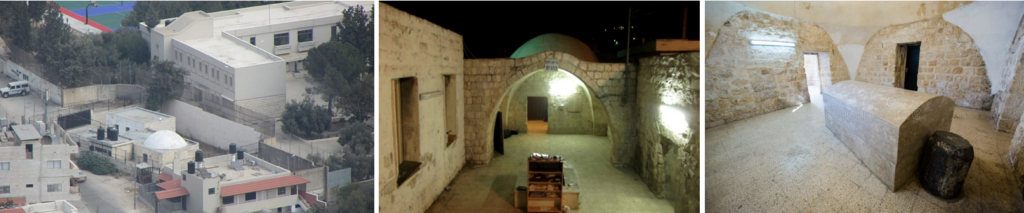
This oath will be fulfilled centuries later, when Joseph’s bones are laid to rest in Shechem, at the entrance to the valley between Mount Gerizim and Mount Ebal.

The current structure of the tomb—a small room topped by a dome—dates from the 19th century. Israel took control of the site in 1967, then, after the Oslo Accords, it came under Palestinian authority. In 2000, at the start of the Second Intifada, the tomb was set on fire. Restored in 2009–2010, it remained accessible only at night under heavy protection.

Since December 29, 2025, a historic decision has allowed daytime visits, up to 8:00 a.m. for the Shacharit prayer, marking a turning point after twenty-five years of nighttime restrictions.