
Beth David Synagogue, Tokyo


Tetzaveh (תצוה – “You shall command”) – Shabbat Zakhor
Exodus 27:20–30:10 — Special Reading: Deuteronomy 25:17–19 — Haftara for Zakhor: I Samuel 15:1–34

G.od instructs Moses to tell the Children of Israel to prepare pure olive oil for the menorah. He describes the garments of the kohanim, their rites of initiation, the inauguration service of the sanctuary, the daily offerings, and the golden altar for incense. Zakhor recalls Amalek’s attack and the command never to forget it, and the haftara recounts the mission entrusted to Saul to destroy Amalek.

Exodus 27:20
וְאַתָּה תְּצַוֶּה אֶת־בְּנֵי יִשְׂרָאֵל… לְהַעֲלֹת נֵר תָּמִיד.
You shall command the Children of Israel… to kindle a perpetual light.

Inaugurated in 2009 and designed by the Japanese architect Fumihiko Maki[1], Beth David Synagogue 🔗 in Tokyo (Jewish Community of Japan – JCJ) features a modern façade of textured concrete, animated by subtle motifs recalling the Star of David.
Inside, the Aron ha‑Kodesh, crowned by a contemporary Ner Tamid[2], stands within a warm ensemble of light woodwork illuminated by the natural light of the central atrium.

During the Second World War, Chiune Sugihara[3], the Japanese consul in Kaunas (Lithuania), defied official orders and issued thousands of visas that enabled Jewish refugees to reach Japan and find refuge there.

Today, a few hundred Jews live in Japan, in harmony with Japanese society. The country is also among those where antisemitic acts are among the rarest in the world.

[1] Fumihiko Maki (1928–2024), world‑renowned Japanese architect, laureate of the Pritzker Prize and the Praemium Imperiale, known for his minimalist approach and subtle use of light and materials.
[2] The Ner Tamid refers back to Tetzaveh, which commands the perpetual light in the sanctuary (Exodus 27:20–21). Talmudic tradition (Menahot 86b) describes the “western lamp” as a perpetual testimony (edut tamid) to the Divine Presence, and Maimonides (Mishneh Torah, Sefer Avodah, Hilkhot Temidin u‑Musafin 3:10–12) details its daily lighting. The Ner Tamid found in synagogues is its symbolic heir.
[3] Chiune Sugihara (1900–1986), Japanese consul in Kaunas in 1940, issued around 2,000 transit visas enabling nearly 6,000 Jewish refugees to escape Nazi‑occupied Europe. He acted against the instructions of his government, sometimes writing visas by hand day and night. Thanks to these documents, refugees were able to reach Japan, mainly Kobe. He was recognized as Righteous Among the Nations by Yad Vashem in 1985.
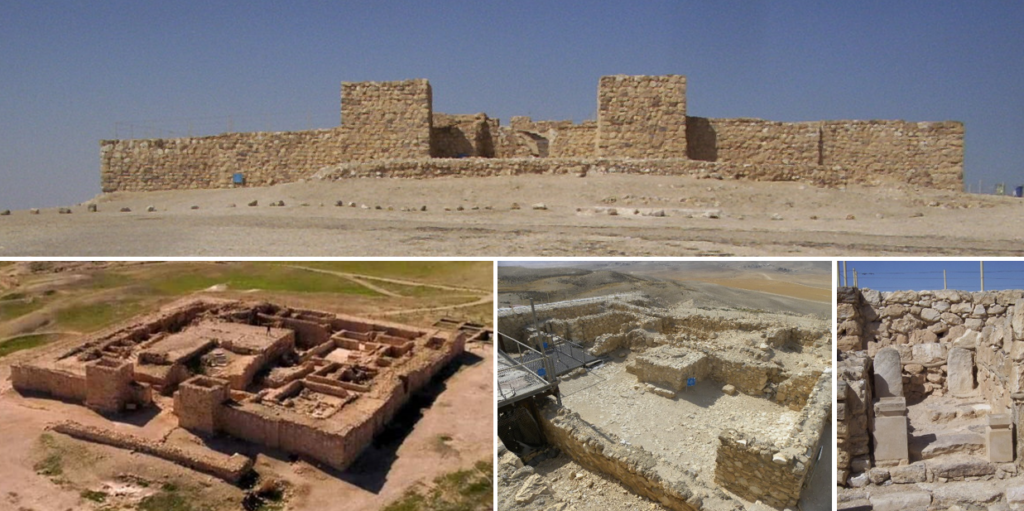

Sanctuary of Arad, Israel

Terumah (תרומה – offering / contribution)
Exodus 25:1–27:19 — I Kings 5:26 – 6:13

God instructs Moses to collect voluntary offerings, given wholeheartedly, in order to provide the materials needed for the construction of the Mishkan.
The haftarah describes the beginning of the construction of Solomon’s Temple.

Exodus 25:8
וְעָשׂוּ לִי מִקְדָּשׁ וְשָׁכַנְתִּי בְּתוֹכָם.
They shall make Me a sanctuary, and I will dwell among them.

The sanctuary of Arad, located in the Negev Desert, was uncovered during the Tel Arad excavations conducted in the 1960s–1970s by Yohanan Aharoni[1], and later revisited and re‑examined by Ze’ev Herzog[2] and the team from Tel Aviv University.
Built within a fortress of the Kingdom of Judah as early as the 10th century BCE, it includes a courtyard, an altar of unhewn stone, a sacred hall, and a raised space interpreted as a “Holy of Holies.
The organization of the site, arranged in concentric degrees of sanctity, directly evokes the structure of the Mishkan.
This sanctuary reflects an ancient cultic tradition practiced in the Kingdom of Judah until the successive reforms of the 8th and 7th centuries BCE led by Kings Hezekiah and Josiah[3], who sought to abolish local sanctuaries in order to centralize divine worship in the Temple of Jerusalem.

[1] Yohanan Aharoni (1919–1976), Israeli archaeologist, pioneer of biblical archaeology.
[2] Ze’ev Herzog (born 1941), Israeli archaeologist, professor at Tel Aviv University.
[3] Hezekiah (Hizkiyahu) and Josiah (Yoshiyahu), kings of Judah in the 8th and 7th centuries BCE.
Hezekiah’s reform is described in II Kings 18–20, especially II Kings 18:1–8, where he abolishes the high places and centralizes worship in Jerusalem.
Josiah continues this process a century later: his reform is recounted in II Kings 22–23, particularly II Kings 23:4–20, where he eliminates provincial sanctuaries.
Parallel accounts appear in II Chronicles 29–32 (Hezekiah) and II Chronicles 34–35 (Josiah), fully accepted in rabbinic tradition.

Usha – Galilee, Israel

Mishpatim (משפטים – Laws / Judgments)
Exodus 21–24 • Jeremiah 34:8–22 (Ashkenazi addition: 33:25–26)

The parashah Mishpatim presents a structured body of civil and social laws that organize justice within Israel. The haftarah from Jeremiah underscores the gravity of abandoning a legal commitment and the spiritual consequences that follow.

Exodus 23:6
(Sefer HaMitzvot, Negative Commandment 273; Mishneh Torah, Hilkhot Sanhedrin 20:4; Sefer HaHinukh no. 83)
לֹא־תַטֶּה מִשְׁפַּט אֶבְיֹנְךָ
You shall not pervert the justice due to your poor.

In the 2nd century CE, Emperor Hadrian[1] undertook the transformation of Jerusalem into a pagan city and imposed severe restrictions on Jewish religious practice. These measures fueled the Bar Kokhba[2] revolt, whose tragic outcome led to an exceptionally harsh Roman repression. The consequences were profound: the mass exile of Jews and, after 135, the renaming of Judea as Syria Palaestina[3], intended to erase the Jewish identity of the land.
The Sanhedrin[4] then relocated to Usha, in the Galilee. There, the sages reorganized legal[5] and communal life, giving lasting structure to the people’s reconstruction.

Archaeological excavations at Usha, conducted since 2010 by the Israel Antiquities Authority (IAA) in collaboration with the University of Haifa, have uncovered a remarkable complex belonging to the 2nd‑century rabbinic center. Archaeologists have exposed residential quarters, craft workshops, and industrial installations. They have also uncovered the remains of a synagogue and study spaces, attesting to an active liturgical and scholarly life. Altogether, these discoveries confirm that Usha was a major communal, legal, spiritual, and social hub.

[1] Hadrian (76–138): Roman emperor whose policy toward the Jews included banning circumcision and several Torah practices, as well as transforming Jerusalem into the pagan colony Aelia Capitolina (c. 130). On the site of the destroyed Temple, he erected a temple dedicated to Jupiter Capitolinus, still mentioned in the 4th century. After the revolt of 135, he forbade Jews from entering the city. These measures remained in force until his death in 138, when his successor Antoninus Pius (86–161), known for his moderation, relaxed several of them, notably the ban on circumcision for Jews.
[2] Bar Kokhba: Leader of the Jewish revolt (132–135), regarded by Rabbi Akiva as a potential Messiah. His defeat resulted in immense loss of life and unprecedented repression.
[3] Before 135, the region bore the names Judea, Samaria, and Galilee. After the revolt, Hadrian renamed it Syria Palaestina to erase its Jewish identity. In the Byzantine period, it was divided into Palaestina Prima (Judea and the coast), Secunda (Galilee and the Jordan Valley), and Tertia (the Negev and the southern Transjordan). The Arab period referred to it as Jund Filastīn (jund: a 7th‑century military district), and the Ottoman period as the Sanjak of Jerusalem (sanjak: administrative district). The name Palestine reappeared officially in 1920 with the establishment of the British Mandate.
[4] The sages of the Sanhedrin in Usha: Rabban Shimon ben Gamliel II (patriarch of the Sanhedrin, overseer of the takkanot of Usha), Rabbi Meir (disciple of Rabbi Akiva, major halakhic authority), Rabbi Yossi ben Halafta (legal authority and historian), Rabbi Shimon bar Yohai (disciple of Rabbi Akiva, major figure of the mystical tradition), Rabbi Elazar ben Shammua (highly respected master of the generation), Rabbi Yehuda bar Ilai (leading posek), and the young Rabbi Yehuda haNasi, future redactor of the Mishnah.
[5] The takkanot of Usha—mentioned in the tractates Ketubot, Bava Kamma, and Bava Batra—establish several foundational principles of Jewish civil law: family responsibility, financial equity, property management, and social organization within the community.

Sarkel (Khazaria), Russia

The Sarkel site in 1930; stelae decorated with a menorah; a yarmaq (Spillings Hoard) — a Khazar coin from the early 9th century bearing the inscription موسى رسول اللهMūsā rasūl Allāh (Moses is the prophet of God) — and the present state of the site.

Yitro (יתרו – Jethro)
Exodus 18:1–20:23 – (Sephardi) Isaiah 6:1–13 – (Ashkenazi) Isaiah 6:1–7:13

Yitro joins Moses and advises him to establish a judicial structure to lighten his burden. The people of Israel arrive at the foot of Mount Sinai and, after a period of purification, receive the Ten Utterances (Aseret ha‑Dibrot). In the haftarah, Isaiah describes his vision of God enthroned and surrounded by seraphim; once purified, he is sent on a prophetic mission. The Ashkenazi reading continues with the announcement of a sign intended to reassure King Ahaz.

Exodus 18:12
וַיִּקַּח יִתְרוֹ חֹתֵן מֹשֶׁה, עֹלָה וּזְבָחִים לֵאלֹקִים; וַיָּבֹא אַהֲרֹן וְכֹל זִקְנֵי יִשְׂרָאֵל, לֶאֱכָל־לֶחֶם עִם־חֹתֵן מֹשֶׁה לִפְנֵי הָאֱלֹקִים.
Jethro, Moses’ father‑in‑law, offered a burnt offering and other sacrifices to God; Aaron and all the elders of Israel came to eat bread with Moses’ father‑in‑law in the presence of God.

Rashi notes in his commentary that Yitro entered “under the wings of the Shekhinah” (נכנס תחת כנפי השכינה), an expression indicating his conversion[1].

Starting in the 8th century, the Khazar elite adopted Judaism. The most valuable accounts of this conversion appear in the Hebrew correspondence between Ḥasdai ibn Shaprut[2] and King Joseph of the Khazars[3]. In his letter, Joseph recounts his lineage, the conversion of his ancestor Bulan, the establishment of a state governed by Jewish rulers, the creation of religious institutions, the adoption of Torah law by the ruling dynasty, the administrative use of Hebrew, and the presence of an influential Jewish community at court.

Excavations at Sarkel — a name probably derived from the Turkic šar (white) and kel/kil (fortress) — were conducted in the 1930s under Mikhail Artamonov[4], before the site was submerged beneath the Tsimlyansk Reservoir. Archaeologists uncovered walls built of white limestone blocks, granaries and storehouses, and residential quarters. Some of the artifacts unearthed there — including a carved stone bearing a menorah, seals, and tamgas (emblems) — are preserved in the museum of Novochekassk, in the Rostov region.

[1] Regarding conversion, the Talmud mentions ritual immersion (Yevamot 46a–47b) and a korban ger, a sacrifice offered at the Temple (Kritot 9a). For men, conversion also includes circumcision (brit milah or hatafat dam brit – Yevamot 46a). Maimonides specifies that the absence of the Temple does not prevent conversion (Issurei Bi’ah 13:5).
[2] Ḥasdai ben Yitzḥak ben Ezra ibn Shaprut (חסדאי בן יצחק בן עזרא אבן שפרוט), a 10th‑century Jewish diplomat, physician, and statesman at the Umayyad court of Cordoba, and protector of the Jewish communities of al‑Andalus.
[3] Joseph, king of the Khazars in the 10th century. Besides his letter to Ḥasdai, his reign is supported by the Schechter Letter (Cairo Geniza), by several Arab geographers of the 9th–10th centuries (al‑Masʿūdī, Ibn al‑Faqīh, al‑Istakhrī, Ibn Ḥawqal), and by Byzantine chroniclers. He presents himself as a descendant of Bulan, followed by Obadiah, Ḥizqiyah, Manasseh, Ḥanukkah, Isaac, Zebulun, Moses, Nissi, Menaḥem, Benjamin, and Aharon. A document dated 985 also mentions David, prince of the Khazars, who may have succeeded him in a later Khazar polity on the Taman Peninsula.
[4] Mikhail Illarionovich Artamonov (1898‑1972), Russian and Soviet historian, archaeologist, and professor, considered the founding figure of Khazar studies; he authored History of the Khazars (1962), the standard reference on the subject.
