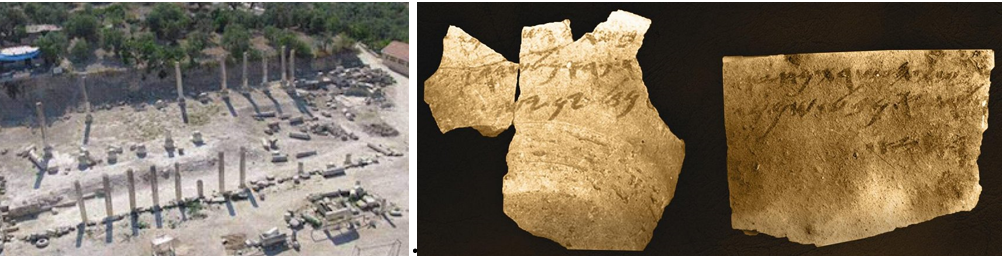
Ostraca from Shomron, Israel

9th–8th century BCE

Vayikra (וַיִּקְרָא – “He called”)
Leviticus 1:1–5:26 — Isaiah 43:21–44:23

Vayikra opens the third book of the Torah, devoted to the service of the Mishkan and to the priestly function. It details the various types of offerings — ‘olah, minḥa, shelamim, ḥatat and asham — and introduces the principle of the qorban, literally a “means of drawing near.” The haftarah from Isaiah evokes Israel as a people “formed to declare My praise.”

Leviticus 2:1
וְנֶפֶשׁ כִּי־תַקְרִיב מִנְחָה
“When a soul presents a minḥa…”

The minḥa[1] is a modest offering, composed of flour mixed with oil and a handful (קֹמֶץ – qomets) of incense[2]. It could be brought at any time of day as an expression of gratitude, devotion, or atonement.

Between 1908 and 1910, excavations at Shomron[3] conducted by George Andrew Reisner[4] uncovered an exceptional group of ostraca dated to the early 8th century BCE. These inscribed potsherds attest to a structured economic and administrative system: networks of collection, redistribution of agricultural produce, and the transport of wine, oil, and other goods.
They shed light on the organization that supported the cult. Recent analyses (2020) carried out at Tel Aviv University reveal a centralized bureaucracy: they indicate that only two scribes — both working in the city of Shomron — wrote the 31 ostraca examined.

In the Roman period, Herod the Great[5] rebuilt the city and renamed it Sebaste. The modern village that now occupies the site bears the name Sebastia, an Arabized form of the ancient name.

[1] The minḥa was often brought by those of modest means (cf. Ramban; Sifra). The incense used was pure levona (frankincense), distinct from the qetoret, a complex blend of eleven aromatics. This offering could be brought after the morning sacrifice and up to, but not including, the onset of night.
[2] Frankincense is a resin extracted from the male tree of the Burseraceae family, notably Boswellia sacra. This tree, native to the Dhofar region (Sultanate of Oman), takes about ten years to produce high‑quality resin.
[3] Shomron (Samaria) was the capital of the kingdom of Israel, founded by King Omri (1 Kings 16:24). The name Sebastos is the Greek form of the Roman imperial title Augustus.
[4] George Andrew Reisner (1867–1942), an American archaeologist trained at Harvard, was one of the pioneers of scientific archaeology in the Near East. His excavations at Shomron (1908–1910) uncovered the first series of Samaritan ostraca, revealing the existence of a structured administrative system in the 8th century BCE. The ostraca are preserved mainly in the Istanbul Archaeological Museum.
[5] Herod I the Great (c. 73–4 BCE), son of Antipater, belonged to the Herodian dynasty. King of Judea from 37 to 4 BCE, he gave the Second Temple its monumental form. His life is known chiefly through the writings of Flavius Josephus.


The Five Types of Qorbanot

– The ‘olah (עֹלָה) is the wholly burnt offering: everything “ascends” to God. It expresses total surrender, a gift without return.
– The minḥa (מִנְחָה), made of flour, oil, and incense, is the simple offering of the humble — a modest gift presented to God.
– The shelamim (שְׁלָמִים) are peace offerings shared between the altar, the priests, and the offerer; they celebrate harmony and gratitude.
– The ḥatat (חַטָּאת) atones for an unintentional sin and restores the balance disrupted by error.
– The asham (אָשָׁם) concerns specific transgressions requiring restitution or reparation; it affirms moral responsibility.
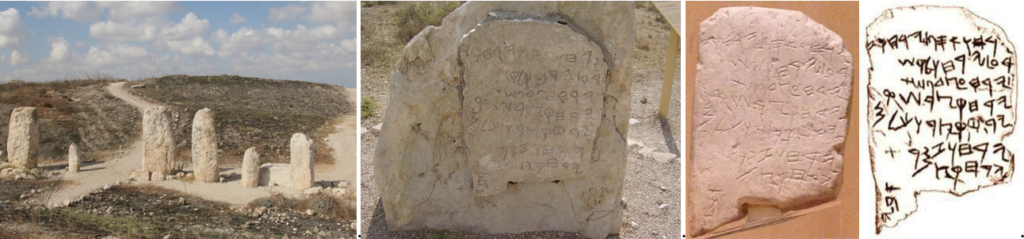

Gezer calendar

10th century BCE

Vayaqhel–Pekudei – Shabbat HaChodesh
ויקהל–פקודי – שבת החודש
“And he assembled” / “Inventory” – Shabbat of the New Month
Exodus 35:1–40:38 — HaChodesh: Exodus 12:1–20 — Ezekiel 45:16–46:18

The portions Vayaqhel–Pekudei recount the completion of the Mishkan, constructed under the direction of Bezalel and Oholiav. Associated with these readings, that of Shabbat HaChodesh introduces the month of Nisan. The corresponding haftarah describes the regulations concerning the future Temple.

Exodus 12:2
הַחֹדֶשׁ הַזֶּה לָכֶם רֹאשׁ חֳדָשִׁים
This month shall be for you the beginning of months.

Discovered in 1908 at the site of Tel Gezer, between Jerusalem and the coastal plain, the Gezer Calendar is a small limestone tablet inscribed in Proto‑Canaanite or Paleo‑Hebrew script, unearthed by R. A. S. Macalister[1]. It is traditionally dated to the 10th century BCE and is among the earliest known examples of Hebrew writing[2]. The original is housed in the Istanbul Archaeological Museum, and a copy is displayed at the Israel Museum in Jerusalem.

The Hebrew calendar is based on a lunisolar system. The year consists of twelve months, to which a thirteenth is added in leap years (seven years within a nineteen‑year solar cycle). The months follow the lunar cycle and contain either 29 or 30 days[3]. The month of Nisan (March/April) marks the beginning of the religious year. The month of Tishri (September/October) is the first month of the civil year. Since the 4th century, the calendar has been based on a fixed calculation attributed to Hillel II[4], ending the monthly proclamation that relied on observing the new moon.

[1] Robert Alexander Stewart Macalister (1870–1950), Irish archaeologist, directed the excavations at Gezer from 1902 to 1909, one of the first large‑scale scientific archaeological digs.
[2] The Paleo‑Hebrew alphabet is a local development of Proto‑Canaanite, used in the kingdoms of Israel and Judah until the Babylonian exile. From the 6th century BCE onward, it was gradually replaced by the square script (Imperial Aramaic), which became the standard Hebrew alphabet in rabbinic tradition.
[3] For months of thirty days, Rosh Chodesh extends over two days. The mean lunar cycle is calculated at 765,433 halakim (29 days = 751,680 halakim; 12 hours = 12,960 halakim; and 44 minutes and 3⅓ seconds = 793 halakim).
[4] Hillel II (c. 320–385), the last Nasi of a still‑functioning Sanhedrin, instituted a calculated calendar to ensure uniform festival dates throughout the Jewish diaspora. This reform ended the monthly proclamation based on observing the lunar crescent.

Neveh Shalom Synagogue, Paramaribo, Suriname

1842

Ki Tissa (כי תשא – When you take) – Shabbat Para
Exodus 30:11–34:35 — Reading for Para: Numbers 19:1–22 — Ezekiel 36:16–38

Ki Tissa recounts the sin of the Golden Calf and the renewal of the covenant following Moses’ prayer. Shabbat Para emphasizes purification through the water mixed with the ashes of the Red Heifer, a prerequisite for drawing close to God once again. Ezekiel’s haftarah extends this theme: God promises to “sprinkle pure water upon Israel” and to give it a new heart.

Numbers 19:2
זֹאת חֻקַּת הַתּוֹרָה, אֲשֶׁר-צִוָּה יְהוָה לֵאמֹר:
דַּבֵּר אֶל-בְּנֵי יִשְׂרָאֵל, וְיִקְחוּ אֵלֶיךָ פָרָה אֲדֻמָּה תְּמִימָה אֲשֶׁר אֵין-בָּהּ מוּם, אֲשֶׁר לֹא-עָלָה עָלֶיהָ, עֹל.
This is the statute of the Torah that the Eternal has commanded: Instruct the children of Israel to bring you a red heifer, whole, without blemish, and upon which no yoke has ever been laid.

The Red Heifer opens the path toward renewal. The community of Jodensavanne[1], founded in the 17th century in the district of Para, is one of the oldest Jewish settlements in the Americas. It developed into an agricultural colony organized around sugarcane, cacao, and coffee plantations. Its gradual decline[2] in the 19th century led its members to regroup in Paramaribo[3], then the administrative and commercial center of the colony, offering greater security and opportunity.

In 1842, the Neveh Shalom Synagogue, designed by architect J. F. Halfhide[4], was inaugurated in the heart of the city. Built in a neoclassical style, it is recognizable by its façade marked by four Ionic columns supporting a triangular pediment. The interior, bright and understatedly elegant, is distinguished by its woodwork, copper chandeliers, and especially its white sand floor[5], which has become one of the most distinctive features of Caribbean synagogues. Since 2002, the historic center of Paramaribo, where the synagogue stands, has been listed as a UNESCO World Heritage Site.

[1] Jodensavanne is a Dutch toponym meaning “the Jews’ savannah.” It refers to the savannah area where the Sephardic Jewish community of Suriname settled.
[2] The decline of Jodensavanne resulted from the collapse of the plantation economy beginning in the late 18th century, worsened by increasing insecurity in the region and by the 1832 fire that destroyed the colony’s center.
[3] The name Paramaribo refers, in all its Indigenous interpretations, to the idea of “river dwellers” or “village by the water.”
[4] Jan François Halfhide, an architect active in Paramaribo during the first half of the 19th century, belonged to a Creole family firmly established in Suriname. He is best known for the reconstruction of the Neve Shalom Synagogue.
[5] The sand floor, characteristic of Caribbean synagogues, evokes both the desert of the Exodus and the discreet practices of the marranos, whose muffled prayers were not to betray their presence. It also serves practical purposes in Suriname’s tropical climate: it protects wooden structures from termites and absorbs humidity.