Vayéchev (וישב – “And he settled”)
Genesis 37:1 – 40:23, Amos 2:6 – 3:8
Yaakov favored his son Yosef and gave him a ketonet passim[1], a sign of distinction that aroused the jealousy of his brothers. Yosef’s dreams, foretelling his future rule over them, further fueled their anger; they sold him to merchants on their way to Egypt.
The narrative is interrupted by the story of Yehudah and Tamar: Yehudah refused to give his youngest son[2] in marriage to Tamar, but she devised a stratagem to obtain justice. From this union were born Peretz and Zerach, ancestors of the messianic lineage.
The haftarah from Amos denounces social injustice and reminds us that faithfulness to the divine covenant requires honesty and integrity.
Genesis 37:3
וְעָשָׂה לוֹ, כְּתֹנֶת פַּסִּים.
And he made him a multicolored tunic.
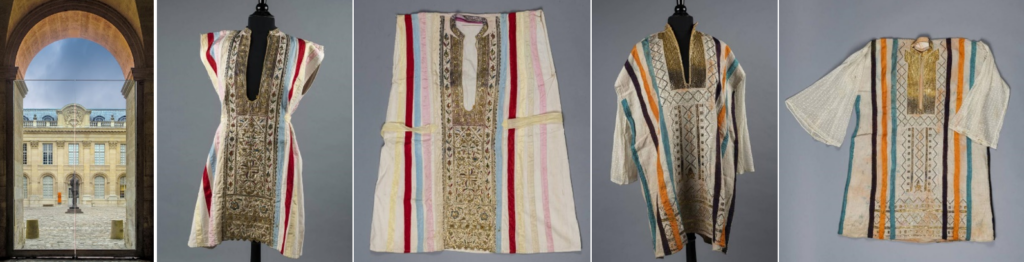
At the Museum of Jewish Art and History (mahJ, Paris), one can admire a multicolored Sephardic tunic[3] originating from Nabeul, Tunisia. This piece is a remarkable example of traditional Jewish textile. Made of cotton and linen, it is decorated with diagonal bands of colorful silk ribbons and a chest panel embroidered with floral motifs in multicolored threads, enhanced with gilded metal plaques. Measuring 92 cm in height and 53 cm in width, it was worn during the henna ceremony preceding marriage. Its rich palette and delicate craftsmanship recall Joseph’s multicolored tunic.
[1] The term Passim (פַּסִּים) appears in Genesis 37:3, 23, 32 (Joseph’s tunic) and 2 Samuel 13:18–19 (Tamar’s tunic). Its meaning is debated: multicolored or variegated; long down to the extremities (rabbinic interpretation); or a princely, luxurious garment reserved for royal daughters (cf. Tamar, daughter of King David).
[2] Levirate marriage (yibbum, יבום) is a biblical prescription: if a man dies without offspring, his brother must marry the widow to perpetuate his name. Mentioned in Genesis 38:7–8 (Tamar and Onan) and formally in Deuteronomy 25:5–10.
[3] The qmejja is a traditional Tunisian wedding tunic, richly embroidered and often multicolored, worn during marriage ceremonies. It is related to the Arabic word qamîṣ (shirt).