Vayigash (ויגש – He Approached)
Genesis 44:18–47:27 – Ezekiel 37:15–28
Judah offers his life to save Benjamin. Moved, Joseph reveals his true identity and reunites the brothers. Jacob migrates to Egypt, bringing together all his descendants. In the haftarah, the prophet Ezekiel foretells the reunification of the two kingdoms, Judah and Israel.
Ezekiel 37:17
וְקָרַב אֹתָם אֶחָד אֶל-אֶחָד, לְךָ–לְעֵץ אֶחָד
Bring these pieces close to one another, so that they become a single piece.
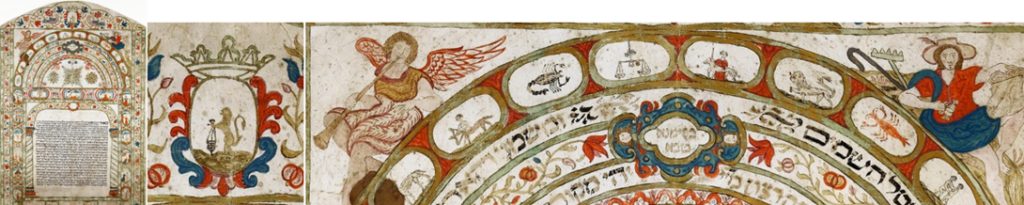
Written in 1700, the Siena Ketubah [1], a masterpiece of Tuscan Baroque [2], is one of the most remarkable examples of 18th‑century Italian Jewish art. It is preserved in the ketubot collection of the Jewish Museum in New York [3].
Within its lavish decoration, we find at the top of the frame an iconographic representation of the Jewish people [4], featuring a lion holding a censer. Below appear the figures of Fame and Profit [5], symbols of renown and prosperity. Next comes a complete zodiac [6]. Medallions depicting biblical scenes, surrounded by carefully chosen verses [7], frame the ketubah text.
[1] Ink, gouache, and gold leaf on parchment, 83 × 58.3 cm. Gift of Dr. Harry G. Friedman. Inventory number: F 2407.
[2] Tuscan Baroque is characterized by abundant ornamentation, dynamic compositions, and allegorical figures.
[3] The Jewish Museum in New York holds one of the world’s most important ketubah collections. The Siena ketubah is considered an exceptional model for its refinement and iconography.
[4] The lion evokes the tribe of Judah (Genesis 49:9), royalty, and power. It represents spiritual strength and divine protection. The censer refers to Temple worship and priestly function.
[5] Fame (an angel blowing a trumpet) is a classical Greco‑Roman allegory of renown and glory. Profit (a man sowing seeds), an allegorical figure from the humanist tradition, embodies prosperity and fertility.
[6] The presence of a complete zodiac (מַזָּלוֹת, mazalot) symbolizes the cycle of time, cosmic order, and divine blessing upon married life. It also evokes providence and good fortune (מַזָּל טוֹב – mazal tov), wished upon the couple.
[7] Biblical verses on the ketubah: Genesis 27:28 “May God give you the dew of heaven…”, Proverbs 18:22 “He who finds a wife finds happiness…”, Proverbs 5:18 “May your fountain be blessed…”, along with a long passage from Isaiah 61:10–62:4, evoking nuptial joy and the restoration of Israel.