Beshalach (בשלח – When He Let Them Go)
Exodus 13:17–17:16 – Judges 4:4–5:31
The departure from Egypt opens the path to freedom. The narrative recounts the parting of the Sea of Reeds, the defeat of Pharaoh’s army, the songs of gratitude sung by Moses and Miriam, the daily gift of manna, water springing from the rock, and the victory over Amalek.
The haftarah also tells of a deliverance: Sisera’s chariots are overturned through divine intervention, enabling Deborah and Barak to win the battle, while Yael, through her decisive act, brings the threat to an end. The account concludes with Deborah’s triumphant song.
Exodus 15:20
וַתִּקַּח מִרְיָם הַנְּבִיאָה אֲחוֹת אַהֲרֹן אֶת־הַתֹּף בְּיָדָהּ
Miriam the prophetess, sister of Aaron, took the tambourine in her hand.
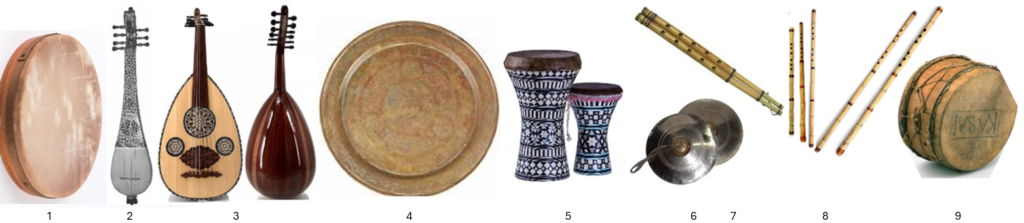
Just as Miriam and the women of Israel celebrated deliverance through music, the Jews of Yemen carried their songs and instruments to the shores of exile, bearing witness that the journey toward freedom is always accompanied by a melody. Their musical tradition, passed down from generation to generation, extended far beyond the tambourine [1] mentioned in the Song of Miriam: it found expression through a whole ensemble of emblematic instruments — qanbûs[2], ‘ud [3], sahn nuḥās [4], darbouka [5], manqûsh / naqûsh [6], mijwiz [7], ney [8], and timbal / mirwās [9].
Exodus of the Yemeni Jews – Following the Aden riots of 2–4 December 1947, which destroyed the Jewish quarter and claimed around ninety Jewish lives, Aden became the main gathering point for the Jews of Yemen before their aliyah. The exodus was organized from the Hashid transit camp (also known as Camp Hashed), near Aden, from which the evacuation of the community was coordinated during Operation Magic Carpet (1949–1950). Over the course of this operation, some 49,000 Yemeni Jews were airlifted to Israel. Today, the Jewish cemetery of Sheikh Othman remains one of the last material witnesses of this long-standing presence in the region.
[1] Tambourine: a small frame drum fitted with cymbal-like jingles.
[2] Qanbûs: a small wooden‑bodied lute, emblematic of Yemen and favored by the master singers of Sanaa and Aden.
[3] ‘Ud: a plucked lute with a rounded body and short neck.
[4] Sahn nuḥās: a large copper tray used as a percussion instrument, particularly in weddings, often played by women.
[5] Darbouka: a goblet‑shaped drum widely used in celebrations.
[6] Manqûsh / naqûsh: a small metal or wooden percussion instrument used to accompany women’s songs.
[7] Mijwiz: a double reed flute producing a continuous sound, especially common in Lebanon, Syria, Jordan, and Israel, with local variants in Yemen.
[8] Ney: a reed flute.
[9] Timbal / mirwās: a small double‑headed drum.