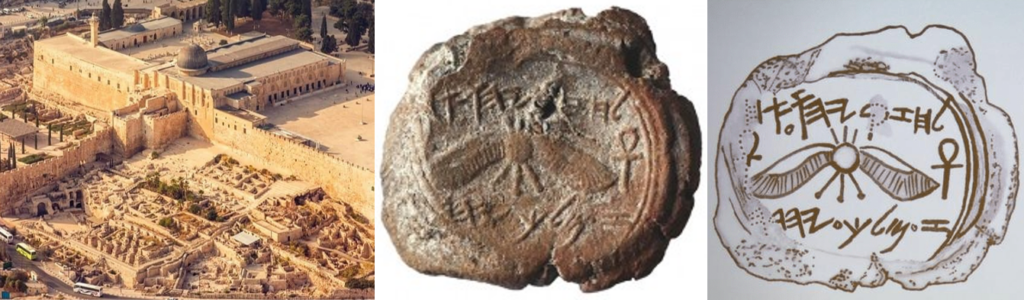
Tsav (צו — “command”), Shabbat Hagadol (שבת הגדול — “The Great Shabbat”)
Leviticus 6:1–8:36 • Malachi 3:4–24
One of the central themes of the parasha Tsav is the perpetual fire on the altar, a sign of the Eternal’s presence among Israel. The haftarah of Shabbat Hagadol echoes this idea through a different image: God appears as a “sun of righteousness,” bringing healing and protection.
Malachi 3:20
וְזָרְחָה לָכֶם יִרְאֵי שְׁמִי שֶׁמֶשׁ צְדָקָה וּמַרְפֵּא בִּכְנָפֶיהָ
“For you who fear My Name, a sun of righteousness shall shine, with healing in its wings.”
This symbol appears precisely on the bulla[1] of Hezekiah, discovered in 2015 during excavations directed by Eilat Mazar[2] in the Ophel[3] area. This clay seal impression — the first attributed with certainty to a king of Judah found in stratified excavations[4] — bears a winged sun[5].
This iconography is characteristic of the end of Hezekiah’s reign[6]: after the Assyrian crisis and his miraculous recovery, the king adopted a symbol expressing divine protection. The royal seals[7] of Judah, previously marked with Egyptian motifs, then shifted toward this winged sun, a symbolic reorientation with theological significance.
[1] Bulla: A small clay seal used to secure documents or objects. Hezekiah’s bulla was found intact, bearing the Hebrew inscription “Belonging to Hezekiah [son of] Ahaz, king of Judah.” It is preserved by the Hebrew University of Jerusalem.
[2] Eilat Mazar (1956–2021): Israeli archaeologist known for uncovering major structures of ancient Jerusalem, notably in the City of David and the Ophel.
[3] The Ophel: The area between the City of David and the Temple Mount, containing administrative buildings and fortifications from the First Temple period.
[4] Stratified context: A discovery made within a datable archaeological layer, ensuring authenticity and provenance — unlike bullae from the antiquities market.
[5] The winged sun: An ancient Near Eastern symbol associated with royal or divine protection. In the Bible, protective wings appear in Exodus 19:4 and Psalm 91:4, while Malachi 3:20 evokes a winged sun-like image, close to the motif on the bulla.
[6] Hezekiah (Hizqiyahu — ca. 715–686 BCE): King of Judah known for his religious reforms, resistance to Assyria, and the episode of his illness followed by miraculous healing (Isaiah 38). His administration is well attested through numerous bullae and the stamped lamelech jars.
[7] Royal seals of Judah – before Hezekiah – often used Egyptian symbols such as the ankh ☥ (life), the scarab 𓆣 (renewal and protection), and the uraeus 𓆗 (royal protection).