Pesaḥ [1] (פֶּסַח – passage / leap)
The readings for Pesaḥ begin with the narrative of the Exodus from Egypt [and, in the diaspora, with the passages concerning the sanctity of the calendar]. Ḥol HaMoed evokes the memory of the exodus, the social laws, the renewal of the covenant, and the Second Pesaḥ. The festival Shabbat highlights the Thirteen Attributes of Mercy and the vision of the dry bones. The seventh day recalls the splitting of the sea as well as the songs of Moses and David. [In the diaspora, the eighth day deals with the laws of tithes and Isaiah’s messianic vision.]
Exodus 14:22
וּבְנֵי־יִשְׂרָאֵל בָּאוּ בְּתוֹךְ הַיָּם בַּיַּבָּשָׁה
The children of Israel entered the sea on dry ground.
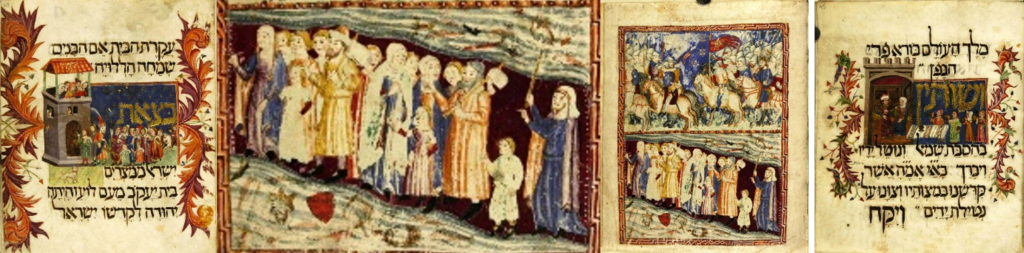
In the Kaufmann Haggadah, an illumination shows, in its lower section, Israel entering the sea while Moses, staff in hand, leads the people. In the upper section, the artist depicts the Egyptian army as medieval knights, transposing the threat of pharaonic Egypt into that of the surrounding Christian societies.
Produced in Catalonia in the 14th century, the manuscript likely left Spain after the Sephardic expulsions and subsequently circulated through Central Europe. Its retouched colors, worn pages, and children’s drawings attest to centuries of use. It was acquired in the 1880s–1890s by Dávid Kaufmann [2]. Committed to preserving the Jewish heritage of Europe, he assembled an exceptional collection [3], which he bequeathed after his death to the Hungarian Academy of Sciences. Its illuminations rank among the finest examples of medieval Jewish art.
[1] First day: Ex 12:21–51, maftir Num 28:16–25, haftarah Josh 3–6. Second day (diaspora): Lev 22:26–23:44, maftir Num 28:16–25, haftarah II Kings 23. Ḥol HaMoed: Ex 13:1–16; Ex 22:24–23:19; Ex 34:1–26; Num 9:1–14. Shabbat of Pesaḥ: Ex 33:12–34:26, maftir Num 28:19–25, haftarah Ezek 37:1–14. Seventh day: Ex 13:17–15:26, maftir Num 28:19–25, haftarah II Sam 22:1–51. Eighth day (diaspora): Deut 15:19–16:17, maftir Num 28:19–25, haftarah Isa 10:32–12:6 (Ashk.) / 11:1–12:6 (Sef.).
[2] Dávid Kaufmann (1852–1899), professor at the Rabbinical Seminary of Budapest and a scholar of exceptional breadth, distinguished himself as a historian, philosopher, bibliographer, and pioneer in the study of Jewish art. A major figure of the Wissenschaft des Judentums*, he contributed to the development of Jewish studies in Central Europe during the 19th century.
* A scholarly movement of the 19th century, born in Germany, aiming to study Judaism through the modern methods of the humanities (history, philology, textual criticism).
[3] The Kaufmann Collection is one of the most important Hebrew collections in Europe. It contains nearly 600 manuscripts, genizah fragments, and about 2,000 early printed books, including several incunabula. It is particularly renowned for its illuminated manuscripts, among which this Haggadah holds a central place. The collection remains a major reference for the study of medieval Jewish art.