Young Israel of West Hartford, Connecticut

Shavuot
Ex. 19:1–20:23 • Num. 28:26–31 • Ezekiel 1:1–28 & 3:12 • Megillat Ruth
[2nd day: Deut. 14:22–16:17 • Num. 28:26–31 • Habakkuk 2:20–3:19]
Nasso (נשא – “Lift up”)[1]
Num. 4:21–7:89 • Judges 13:2–25

The readings for Shavuot include the account of the Giving of the Torah, Ezekiel’s vision of the Heavenly Chariot, and the departure of Ruth from Moab, her arrival in Bethlehem, and her gradual integration into her new home.

The readings for Nasso present the organization of the Levites, the ritual of the Sotah (a woman suspected of adultery), the laws of Naziriteship, and the Priestly Blessing. The haftarah announces the birth of Shimshon, the Nazirite.

Ruth 1:19
וַתֵּלַכְנָה שְׁתֵּיהֶם עַד־בֹּאָנָה בֵּית לָחֶם
“The two of them walked on until they came to Bethlehem.”

Jews arrived in Hartford as early as the 19th century, and gradually moved during the 1950s–1960s to the neighboring city of West Hartford. From this migration emerged a Modern Orthodox[2] nucleus that eventually formed the Young Israel[3] community.

An ‘eruv[4] ḥatserot, inspected every Friday, encompasses the neighborhoods surrounding the Young Israel of West Hartford synagogue. The contemporary‑style building stands within a quiet, tree‑lined residential environment.


[1] In the diaspora, when Shavuot lasts two days and the holiday falls on a Friday (Yom Shishi), the reading of Nasso is shifted by one week compared to the calendar in Israel.
[2] Modern Orthodox: A stream of North American Orthodox Judaism combining halakhic observance with active engagement in broader society.
[3] Young Israel: A network of Orthodox synagogues founded in the United States in 1912, historically associated with Ashkenazi Modern Orthodox communities.
[4] The ‘eruvin:
Eruv ḥatserot — Allows carrying objects on Shabbat within a defined shared domain (Mishnah Eruvin 6–7; Bavli Eruvin 71a–82b; Shulḥan Arukh, OḤ 366–370).
Eruv techumin — Establishes the permitted walking boundary around a town up to 2,000 cubits (Mishnah Eruvin 4:3; Shulḥan Arukh, OḤ 397).
Eruv tavshilin — Allows Shabbat preparations to be performed on a Yom Tov that falls on Friday (Bavli Beitza 15b; Shulḥan Arukh OḤ 527).
Simplified procedure: prepare two cooked foods, recite the berakhah of the eruv, then consume them on Shabbat, preferably at se‘udah shelishit (OḤ 527:2, 527:12, 527:14; Mishnah Berurah 527:48; Kaf Haḥayim 527:48).

Ksar of Amezrou, Morocco

Bamidbar (במדבר / Ba‑Midbar, “In the Desert”)
Numbers 1:1–4:20 • Hosea 2:1–22 • Pirkei Avot, chap. 6 (Perek Kinyan Torah [1])

In the desert, Moses conducts the census of Israel, organizes the placement of the tribes around the sanctuary, and entrusts the Levites with their responsibilities. The desert is not only a place of passage: it becomes the space where the people are structured and receive a collective mission. The prophet Hosea evokes the desert as a place of return and of rediscovered speech. It is in this stripped‑down space that a bond can be repaired.

Hosea 2:16 [2]
לָכֵן הִנֵּה אָנֹכִי מְפַתֶּיהָ וְהֹלַכְתִּיהָ הַמִּדְבָּר וְדִבַּרְתִּי עַל־לִבָּהּ
“Therefore, here I am: I will allure her, I will lead her into the desert, and I will speak to her heart.”

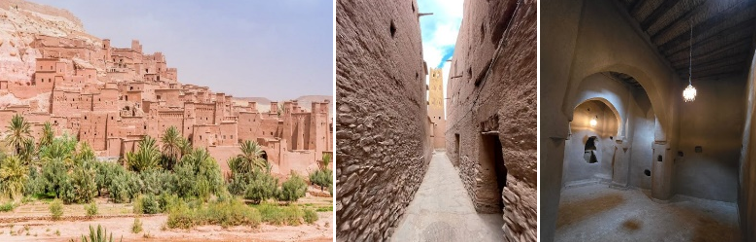
At the entrance to the desert, in the ksar of Amezrou, near Zagora, this fortified village—historically linked to Saharan caravan routes [3]—once housed a rural and oasis‑dwelling Jewish community of southern Morocco, belonging to what can be described as Judeo‑Berber Judaism[4].

Throughout the Drâa Valley, silversmithing and jewelry‑making[5], practiced notably by Jewish artisans, were traditional local activities.

In the early 1960s, the Jews gradually left Amezrou for Israel, in the context of post‑independence Morocco. The departure of the last families took place around 1962–1963.

The Amezrou synagogue, built of rammed earth (pisé), still stands today at the heart of the ksar, in the former mellah. Its Aron ha‑Kodesh is carved into the eastern wall, and its roof rests on palm‑tree beams, following traditional techniques.

[1] Kinyan Torah (קניין תורה), “acquisition of the Torah,” is the traditional name given to chapter 6 of Pirkei Avot. This chapter emphasizes the value of Torah study and the dispositions through which it is acquired, notably the list of the forty‑eight ways of acquiring the Torah.
[2] Use of the feminine: Hosea uses the image of the wife to express the relationship between God and Israel.
[3] Historical context: The ksar of Amezrou is part of the system of fortified villages of southern Morocco, developed along Saharan caravan routes. These structures shaped settlement, trade, and communal life among oasis populations—Muslim and Jewish—in the Drâa Valley.
[4] The expression Judeo‑Berber refers to the diversity of Jewish communities of the Maghreb who lived in Berber‑speaking environments.
[5] Silversmithing and jewelry‑making are attested as traditional activities of the Drâa Valley, historically associated with the Jewish presence in the region’s ksour.

La Paz, Bolivia

Behar – Be’hukotai
(בְּהַר – בְּחֻקֹּתַי / On the mountain – According to My statutes)
Leviticus 25–27 • Haftarah: Jeremiah 16,19 – 17,14 Pirkei Avot, chapter 5

God speaks “on the mountain,” revealing laws concerning the land, rest, and social justice. He promises that if Israel walks in His ways, He will lead it forward in elevation and dignity. The prophet Jeremiah affirms that even in exile, the promise of the land endures.

Leviticus 26:13
וָאוֹלֵךְ אֶתְכֶם קוֹמְמִיּוּת
“I made you walk in uprightness and elevation.”

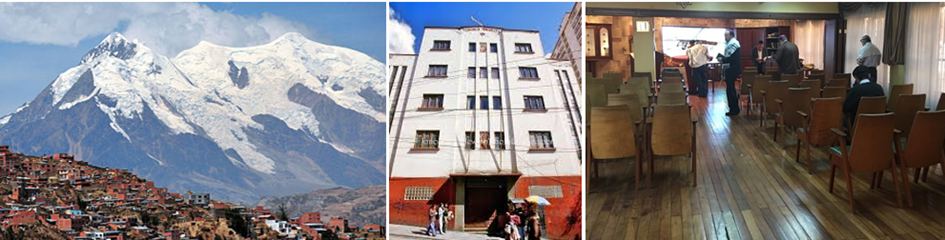
La Paz lies in a steep valley of the Andes Cordillera, dominated by the silhouette of Mount Illimani [1]. The Círculo Israelita de Bolivia synagogue is widely cited as the highest synagogue in the world, located at approximately 3,650 meters above sea level.

Jewish presence in Bolivia is attested prior to the twentieth century (with conversos in the sixteenth and seventeenth centuries), but the community took shape primarily from 1938 onward, when Bolivia opened its borders to Jewish refugees fleeing Nazi persecution. According to historian Leo Spitzer[2], several thousand Jewish refugees arrived in the country between the late 1930s and the early 1940s, laying the foundations of a structured communal life through the creation of religious, educational, and cultural institutions.

After reaching a peak in the 1950s, the Bolivian Jewish community experienced steady emigration to Israel and the Americas. Today, only a small core remains[3], mainly in La Paz and Santa Cruz.


[1] Illimani is a name of Aymara origin. Aymara, together with Spanish and Quechua, is one of Bolivia’s three official languages. The name is commonly interpreted as “mountain of light / protective spirit of light,” in reference to the reflection of sunlight on its eternal snows, though other interpretations evoke the image of a luminous condor.
[2] Leo Spitzer, Hotel Bolivia: The Culture of Memory in a Refuge from Nazism, Hill & Wang, 1998. Estimates of the number of Jewish refugees welcomed by Bolivia between 1938 and the early 1940s vary by source; Spitzer, drawing on testimonies and contemporary documents, suggests a total that may have reached nearly twenty thousand people.
[3] The Times of Israel, “In La Paz, Bolivia, a Symbol of Jewish Resilience,” October 5, 2024. The article describes the current life of the Círculo Israelita de Bolivia and highlights the vitality of a community that is now small but active.