Shoftim (שֹׁפְטִים — Judges)
Deuteronomy 16:18–21:9 • Isaiah 51:12–52:12
Moses commands Israel to appoint judges and officers; the haftarah proclaims that God is the ultimate judge and comforter, promising Zion that she will not be forgotten.
Shoftim 16:18
וְשֹׁפְטִים וְשֹׁטְרִים תִּתֶּן־לְךָ בְּכָל־שְׁעָרֶיךָ
“You shall appoint judges and magistrates for yourself in all your gates.”[1]
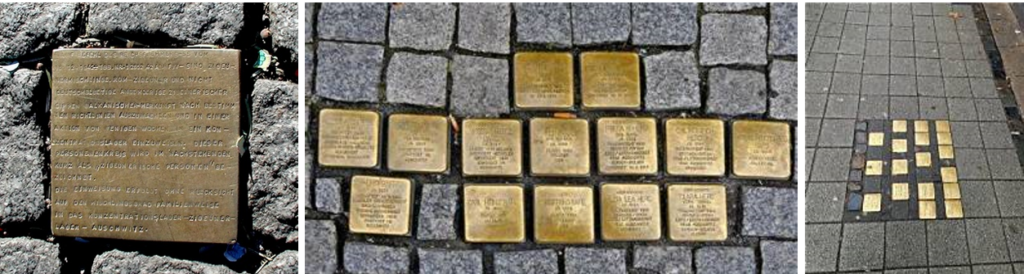
On the sidewalks of Berlin, more than 11,000 stones[2] commemorate individuals persecuted under Nazism. Created by the German artist Gunter Demnig[3], the Stolpersteine[4] are placed in front of the last residence these people were able to choose before persecution tore them away.
Under the Nazi regime, persecuted individuals were gradually stripped of their rights, their property, their freedom, and—tragically for many—their lives. Reduced to categories and numbers, their memory was erased from public space. Gunter Demnig’s project seeks symbolically to reverse this process by reintroducing names into the streets and places of daily life. Each stone bears the person’s name, date of birth, and—when available—brief information about their fate. The name thus returns to the very space where that person once lived.
The passerby must stop and bend down to read the name engraved on the stone— the name of someone whom the Nazi regime sought to erase.
[1] Before each installation, the Koordinierungsstelle Stolpersteine Berlin verifies that the chosen address truly corresponds to a residence selected by the person before dispossession or forced assignment, and not to a location imposed by persecution measures. This case‑by‑case verification determines whether a stone may be placed.
[2] Stolperstein: A 10 × 10 cm concrete block topped with a hand‑engraved 10 × 10 cm brass plate. Today, more than 126,000 Stolpersteine have been installed in Germany and in 31 other European countries, making it the largest decentralized memorial in the world. In Berlin, more than 11,000 are visible throughout the city.
[3] Gunter Demnig, a German artist born in Berlin in 1947, is the initiator of the Stolpersteine. In May 1990, he painted the deportation route of 1,000 Sinti and Roma from Cologne to the Deutz railway station (May 1940), a first gesture foreshadowing the project. On 16 December 1992, marking the fiftieth anniversary of Himmler’s decree ordering their deportation, he laid a first isolated stone in front of Cologne’s city hall. Serial installation began in January 1995 in Cologne and continued in Berlin from 1996 onward. Demnig emphasizes the uniqueness of each person: one stone, one name, one story. He links this approach to a Talmudic idea: “A person is forgotten only when their name is no longer remembered.”
[4] The name Stolpersteine means “stones one stumbles upon.” Demnig speaks of a “mental stumbling”: the passerby stops, reads, and remembers. He also cites a student’s remark: “You do not trip over the Stolpersteine; you trip with your head and your heart.”