Lekh Lekha (לֶךְ־לְךָ – “Go for yourself” or “Go to yourself”)
Bereshit 12:1-17:27; Yeshayahu 40:27-41:16
In the Parashah, G-d commands Avram to leave his homeland and journey toward a land that He will show him. In the Haftarah, the prophet Yeshayahu addresses a discouraged Israel in exile and reminds it that it is descended from Avraham, the friend of G-d, and that G-d will give it the strength to continue on its way.
Bereshit 12:1
לֶךְ־לְךָ מֵאַרְצְךָ וּמִמּוֹלַדְתְּךָ וּמִבֵּית אָבִיךָ אֶל־הָאָרֶץ אֲשֶׁר אַרְאֶךָּ
“Go forth from your land, from your birthplace and from your father’s house, to the land that I will show you.”
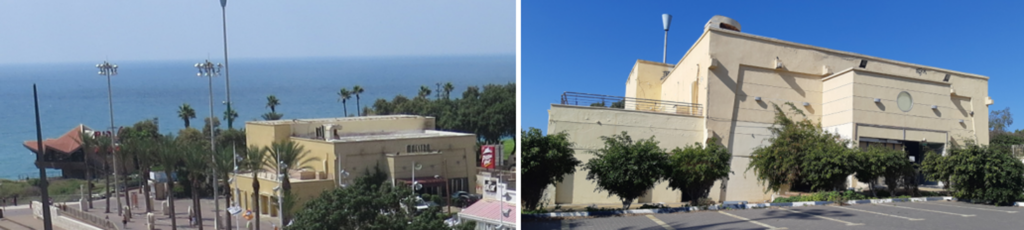
In 1936, Netanya, a small agricultural town founded in 1929, opened an 800-seat cinema. Located a short distance from the sea, on Independence Square, it became the city’s first cultural center. Its basement served as the first refuge for the ma’apilim.[1] After a screening, they would leave the theater mingled with the audience in order to escape inspections by the British authorities charged with preventing Jewish immigration. They were then transferred to other locations, where they hoped to build a new life.
Between 1937 and 1940, Sironit-Herzl Beach in Netanya was an important landing point[2] for the Aliyah Bet.[3] The ma’apilim, men, women and children, left their native countries to reach Eretz Israel. They landed at night before being led to the Esther Cinema.
Unable to compete with modern multiplexes, the theater gradually lost its audience and closed in the early 1990s. In March 2024, the Esther Cinema, a refuge for those who came to build their lives in Eretz Israel, was demolished.[4] A hotel, shops and residential buildings are to be built on the site.[5]
With its disappearance, the city loses part of its history. A gallery intended to recall this past has been announced, a pale reminder of such a remarkable chapter, one that deserved a true place of remembrance.
[1] The Hebrew term ma’apilim (מעפילים) means “those who go up” and refers to Jews who entered Eretz Israel clandestinely. Derived from the root עפל, the term refers more specifically to immigrants who entered Eretz Israel without the authorization of the Mandatory authorities.
It is the verb used in Bamidbar 14:44, when men ascend the mountain despite Moshe’s prohibition.
The Parashah Lekh Lekha also employs the verb “to go up” (עלה), from which the term aliyah, immigration to Eretz Israel, is derived: “Avram went up from Egypt, he, his wife, all that he possessed, and Lot with him, toward the Negev” (Bereshit 13:1).
[2] According to Rabbi Ervin Birnbaum (1930-2024), a witness to the Aliyah Bet, a passenger aboard the Exodus in 1947, and the author of numerous studies on clandestine Jewish immigration, as cited by ESRA magazine, Netanya played a central role in organizing clandestine immigration. His wife, Hadassa Birnbaum, reported that the owner of a nearby kiosk would offer drinks to British officers in order to divert their attention. Local residents then carried the ma’apilim on their backs from the beach to the cinema.
[3] Aliyah Bet refers to the organized immigration that took place between 1934 and 1948 outside the quotas imposed by the British Mandate authorities. The newcomers landed mainly along the coast, often at night, before being hidden and later distributed among various localities.
[4] The demolition of the Esther Cinema began in March 2024, a few days after the re-election of Mayor Miriam Feirberg-Ikar (1951-2025), who had held office since 1998.
In 2006, Tras Investments acquired the site for 28 million shekels.
In 2009, an agreement with the municipality provided for the reconstruction of the cinema, together with a museum dedicated to the history of Netanya and a tourist information office.
In 2015, the reconstruction project was transformed into a demolition project and sparked a campaign in favor of preserving the building.
From 2017 to 2021, the real estate project was approved and subsequently revised; the final decision authorized the construction of a tower on the site of the cinema.
[5] The Esther project includes a five-star hotel with 150 rooms, 58 luxury apartments, shops, and a memorial space intended to recall the history of the vanished cinema.