Schwerin, Germany

1819/2008

Hukat [1] (חֻקַּת — divine law without explicit reason)
Numbers 19:1–22:1 • Judges 11:1–33

The portion opens with the red heifer, then recounts the deaths of Miriam and Aaron, and Moses’s sin at the rock. The haftarah tells the story of Jephthah, illegitimate son, driven out by his brothers, who took refuge in the land of Tob before being recalled by the elders of Gilead.

Judges 11:2
ויגרשו אתיפתח ויאמרו לו לאיתנחל בביתאבינו כי בןאשה אחרת אתה
“They drove out Jephthah and said to him: you shall have no inheritance in our father’s house, for you are the son of another woman.”

Born in 1927, William Wolff was driven out of Germany in 1933 by the rise of
Nazism; his family settled in London in 1939. He became a journalist, and then, in
1984, a rabbi — at the age of fifty-seven. In 2002, he was called to Schwerin as
Landesrabbiner [2] . In 2014, he received honorary citizenship of the city.

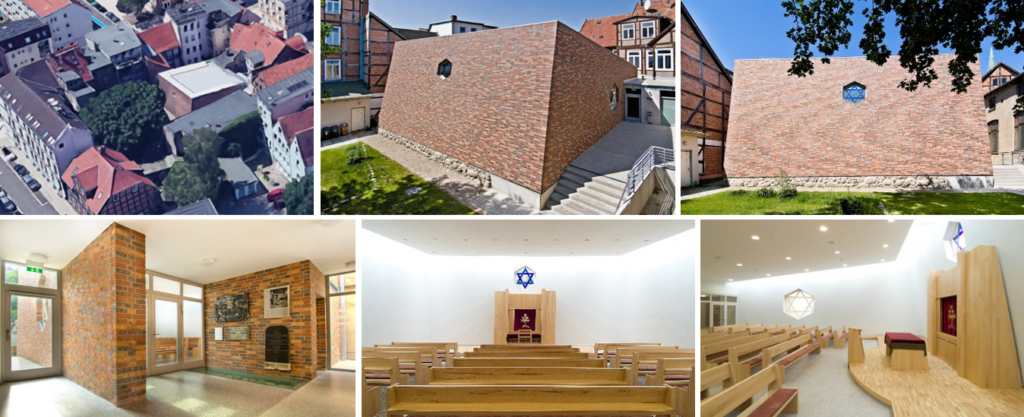
The synagogue of the Jüdische Gemeinde of Schwerin, built on the site of the two
synagogues destroyed in 1938, was realised at the initiative of the Jewish
community with the support of the Land [3] . Constructed in 2008 by the architects
Joachim and Matthias Brenncke [4] , it presents itself as a contemporary volume in
dark red brick, crowned by a sloping roof that opens into a skylight toward the
heavens. Excavations revealed the foundations and paving stones of 1819, now
integrated into the new building.

[1] In the diaspora, the portion read this week is Korah.
[2] The Landesrabbiner — state rabbi — is the official representative of the Jewish
community before the authorities of the Land. The post, which had existed in
Mecklenburg since the nineteenth century, had remained vacant throughout the Nazi
and Communist periods. Wolff became its first holder in more than sixty years.
[3] The financial support of the Land of Mecklenburg-Vorpommern is part of the
German policy of support for Jewish life and acknowledgment of local history, following the destruction of 1938 and the absence of reconstruction during the
Communist period.
[4] Joachim and Matthias Brenncke, architects in Schwerin, partners of the firm
Brenncke Architekten.

Kfar Etzion, Judea, Israel

Qoraḥ (קֹרַח)[1]
Numbers 16:1–18:32 • 1 Samuel 11:14–12:22

The ambitious Qoraḥ challenges the authority of Moshe and Aharon. To settle the dispute, Moshe places the staffs of the leaders of the twelve tribes in the Tabernacle. By morning, only one has blossomed. The haftara reminds us that legitimate authority is proven through deeds — not ambition.

Numbers 17:23
וַיְהִי מִמָּחֳרָת, וַיָּבֹא מֹשֶׁה אֶל־אֹהֶל הָעֵדוּת, וְהִנֵּה פָּרַח מַטֵּה־אַהֲרֹן לְבֵית לֵוִי; וַיֹּצֵא פֶרַח וַיָּצֵץ צִיץ, וַיִּגְמֹל שְׁקֵדִים.
“On the following day, Moshe entered the Tent of Testimony, and behold, the staff of Aharon, for the house of Levi, had blossomed: it had produced buds, brought forth flowers, and borne almonds.”

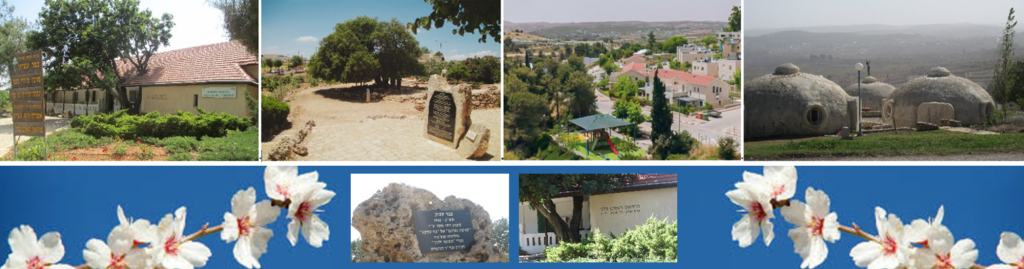
A staff cut from its root, presumed dead, yet blooming again — this is the very image of Kfar Etzion[2]. In the Judean hills south of Jerusalem, this kibbutz was founded in 1927, destroyed [3] several times, and finally razed on 13 May 1948 [4], on the eve of the proclamation of the State of Israel.

During the nineteen years of Jordanian occupation, the expelled families would climb the heights of Jerusalem, to the lookout point of Ramat Raḥel, from where they could glimpse in the distance the Oak of Gush Etzion [5]. After the Six-Day War[6], the descendants of the founders returned and rebuilt the kibbutz on its original site.

Today, Kfar Etzion is a religious Zionist kibbutz of about 1,200 residents. It hosts a mekhina (מכינה) [7] among the most renowned in the country, a museum recounting the history of Gush Etzion, and various educational and tourist activities. The community also operates a guesthouse complex (zimmer) for visitors. Faithful to its agricultural vocation, the kibbutz cultivates apple orchards, cherry trees, vineyards, and almond groves.


[1] The parasha read this Shabbat in the diaspora is Shelakh Lekha.
[2] The name Etzion was chosen in honor of Shmuel Zvi Holtzman (1883–1960), who acquired the land in the 1930s; the name plays on the German Holz (“wood”), linked to the Hebrew etz (עץ), “tree/wood.”
[3] The four foundations of Kfar Etzion:
1927–1929 under the name Migdal Eder (מגדל־עדר), mentioned in Genesis 35:21; destroyed during the 1929 riots.
1934–1936: the El HaHar company reestablishes the settlement; abandoned during the Arab Revolt.
1943–1948: refounded by Hapoel HaMizrachi (est. 1922), committed to the ideal “Torah and labor”; on 13 May 1948, 127 defenders were massacred after surrendering, four prisoners survived.
Since 25 September 1967: refounded by the descendants of the 1948 inhabitants.
[5] The Oak of Gush Etzion is a centuries‑old tree (600–700 years), visible from Jerusalem, and a symbol of the Gush Etzion region.
[6] Arab coalition in the Six-Day War: Egypt, Jordan, and Syria (principal belligerents), Iraq (troops in Jordan), Saudi Arabia and Kuwait (contingents), with political or logistical support from Algeria, Morocco, Sudan, and Tunisia.
[7] Mekhina: a religious and military preparatory academy for young Israelis before their service in the IDF; it combines Torah study, civic education, and physical training.

Tel Susya, Israel

Shelach Lekha [1] (שְׁלַח לְךָ – “send for yourself”)
Numbers 13:1–15:41 • Joshua 2:1–24

Twelve scouts are sent to survey the Land of Israel. Caleb and Joshua remain confident in the divine promise, but the report of the other ten causes the people to lose heart. The book of Joshua recounts in turn the sending of two spies to Jericho.

Numbers 13:23
וַיָּבֹאוּ עַד־נַחַל אֶשְׁכּוֹל וַיִּכְרְתוּ מִשָּׁם זְמוֹרָה וְאֶשְׁכּוֹל עֲנָבִים אֶחָד
“They reached the valley of Eshkol [2] and cut from there a branch with a single cluster of grapes.”

Mentioned in the biblical narrative, this valley lies in the Hebron region, south of the Judean hills. The importance of viticulture in this area has been attested since antiquity, notably at Susya. Excavations [3] have uncovered a large winepress carved into the rock, dated to the 5th or 6th century, along with several agricultural installations. Near the winepress, the remains of the Byzantine synagogue, built in the 4th century and used until the 8th, bear witness to the vitality of the Jewish community that inhabited the site during this period. The building, oriented toward Jerusalem, still preserves its mosaic floor and several Hebrew inscriptions. The ensemble illustrates the prosperity of a village where wine production played a central role in both economic and religious life. Even today, viticulture remains vibrant, sustained by renowned wines such as Hebron Heights Cabernet Sauvignon.


[1] In the diaspora, the weekly Torah portion read this week is Beha’alotekha.
[2] Eshkol (אֶשְׁכּוֹל) is a Hebrew term meaning a cluster of grapes. The word derives from a root expressing the idea of a compact grouping or tightly bound cluster, reflecting the structure of the grape cluster itself. In the Tanakh, it becomes a sign of the fertility and richness of the Land of Israel, and a symbol of abundance associated with divine blessing.
[3] Excavations carried out by Ze’ev Yeivin, Amnon Negev, and Yitzhak Magen, archaeologists affiliated with Israeli heritage institutions (including the Israel Antiquities Authority and the Civil Administration of Judea and Samaria), specialists in Byzantine‑period archaeology in Judea and in Jewish villages of that era.