Ekev (עֵקֶב — “Because” / “heel”)
Deuteronomy 7:12–11:25 • Isaiah 49:14–51:3
Moses promises Israel the abundance of the land that the Eternal gives them, on condition that the people never forget, once they are satisfied[1], that this prosperity comes from God. After describing the richness of the Land, he warns against the danger of a heart that grows proud of its success and forgets the One who is its source. Isaiah, in the haftarah, responds to Zion, who believes herself abandoned: “Can a woman forget her nursing child?” (49:15).
Deuteronomy 8:8
אֶרֶץ חִטָּה וּשְׂעֹרָה, וְגֶפֶן וּתְאֵנָה וְרִמּוֹן; אֶרֶץ־זֵית שֶׁמֶן, וּדְבָשׁ.
“A land that produces wheat and barley, grapes, figs and pomegranates, oil‑rich olives, and honey.”
In 1889, more than 130 families from Podolia[2], driven to emigrate by anti‑Jewish persecutions, arrived in Buenos Aires aboard the SS Weser[3]. The lands promised near La Plata proved unavailable; Pedro Palacios, a landowner, sold them land in the province of Santa Fe[4]. The families settled there, but faced typhus, hunger, and severe hardship.
On 11 September 1891, Baron Maurice de Hirsch[5] founded the JCA to support and develop existing Jewish agricultural colonies[6]. Under the spiritual leadership of Rabbi Aharon Halevi Goldman[7], the village took the name Moisés Ville[8], in reference to Moses our Teacher, who led his people from a land of oppression to a land of refuge.
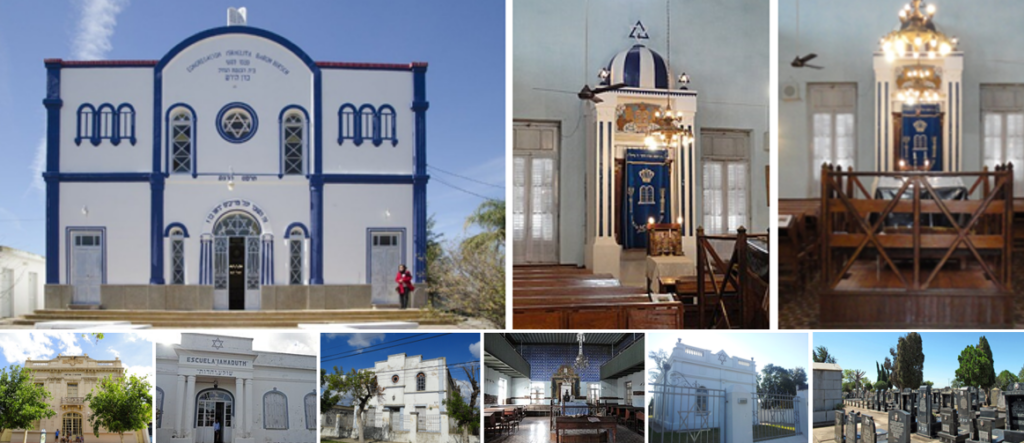
The Barón Hirsch Synagogue[9], the only one still active, was built shortly after the settlers’ arrival and rebuilt in 1927: the side rooms reserved for women were demolished in favor of an upper balcony integrated into the main hall. Its bimah, made of wood by the first cattle‑raisers, evokes a pampa corral, symbolizing the encounter between Jewish tradition and local culture. The Jewish population declined sharply during the 20th century, many descendants of the settlers having moved to the major cities. Their epic is immortalized by the Argentine writer Alberto Gerchunoff in Los Gauchos Judíos (1910).
[1] Birkat Hamazon
Deuteronomy 8:10: “You shall eat, you shall be satisfied, and you shall bless the Eternal your God for the good land He has given you.” This verse is the rabbinic source of Birkat Hamazon (Tosefta Berakhot 6:1; see also Sefer HaHinnoukh, mitzvah 430).
[2] Podolia
A region of the Russian Empire (now Ukraine), Podolia was an important center of Jewish emigration, driven by pogroms and antisemitic violence, toward the Americas at the end of the 19th century.
[3] Voyage of the SS Weser
The families left Kamenetz‑Podolsk, in Podolia, reached Bremerhaven in Germany, where they boarded the SS Weser. They landed in Buenos Aires on 14 August 1889.
[4] Hernández and Palacios land contracts
The Podolians suffered a double deception. The first settlement project, concluded in Paris with landowner Rafael Hernández for land near La Plata, failed when he withdrew from the sale after a sharp rise in land prices. Redirected to Pedro Palacios, the families entered a new contract under unfavorable conditions: the land was sold to them at a price far above market value (4 to 10 times the usual rate), and the housing, tools, and seeds promised in the contract were never delivered.
[5] Maurice de Hirsch (1831–1896)
Born in Munich into an ennobled Bavarian Jewish family, he made his fortune in railways and banking before devoting himself to Jewish philanthropy. The death of his only son, Lucien de Hirsch de Gereuth (1856–1887), left him without an heir; following this bereavement, he declared that he wished to make humanity his heir and dedicated most of his fortune to the creation of Jewish agricultural colonies. His wife, Baroness Clara de Hirsch, built the Lucien‑de‑Hirsch School in Paris in 1901, originally intended for the integration of immigrant Jewish children, in memory of their son. Maurice de Hirsch died in Hungary in April 1896 and was buried in Paris at the Montmartre Cemetery.
[6] Jewish Colonization Association (JCA)
The JCA acquired over the years more than 600,000 hectares of pampa in Argentina, consolidating and financing on a larger scale colonies already in existence, including Moisés Ville.
[7] Rabbi Aharon Halevi Goldman (1853–1932)
Considered the first rabbi to settle permanently in Argentina. Arriving aboard the SS Weser, he founded the main religious and educational institutions of the colony. He maintained correspondence with several rabbinic authorities of his time; his responsa were published under the title Divrei Aharon (Jerusalem, 1981). He is buried in the historic cemetery of Moisés Ville.
[8] Origin of the name Moisés Ville
According to local tradition, Rabbi Goldman, at the request of Pedro Palacios, proposed the name Kiriat Moshé, explicitly referring to Moses our Teacher leading his people toward the Promised Land. An agent named Horovich, who did not speak Spanish, is said to have translated this name into French as “Moïse ville”; it was then transcribed into Spanish as “Moisés Ville.”
[9] Jewish communal buildings of Moisés Ville
In addition to the Barón Hirsch Synagogue (1920), the community includes the Brener / Beit Midrash Agadol Synagogue (1905), the Lituana Synagogue (1915), and the Obrera / Arbeter Shoul Synagogue (1916), as well as cultural and educational institutions: the Barón Hirsch Popular Library (1913), the Kadima Cultural Center and Theater (1909), the Iahaduth Jewish School (early 20th century), and the Museum of Jewish Colonization and Local History (20th century). The Jewish cemetery (1891) is the oldest Jewish cemetery in Argentina.