Vaet’hanan (ואתחנן — “I pleaded”)
Shabbat Naḥamu (שבת נחמו — Shabbat of Consolation)
Deuteronomy 3:23–7:11 — Isaiah 40:1–26
Despite his supplications, Moses is not granted permission to enter the Land of Israel. He reminds the people of the Ten Utterances and proclaims the central Jewish profession of faith, the Shema Israel. The haftarah from Isaiah opens the seven haftarot of consolation that follow Tisha BeAv: even in dispersion, God never abandons His people.
Deuteronomy 3:25
אֶעְבְּרָה־נָּא וְאֶרְאֶה אֶת־הָאָרֶץ הַטּוֹבָה
“Let me cross over, I pray, and see the good land.”
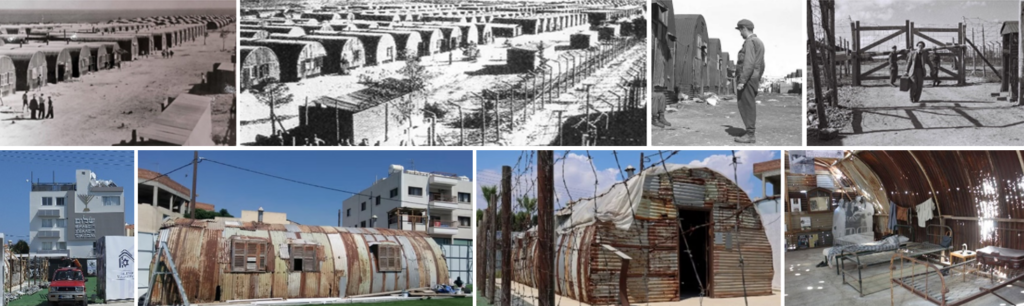
The Jews were denied access to the Land of Israel by the British government[1]. Between August 1946 and February 1949, the Royal Navy intercepted at sea the ships carrying more than 52,000 Jews[2], most of them survivors of the Shoah. They were interned in camps[3], housed depending on the site either in Nissen huts[4] or in tents, behind double electrified fences watched by guard towers spaced roughly one hundred meters apart, on the island of Cyprus.
One of these Nissen huts, later converted into an agricultural shed, was identified during a visit to the Famagusta region by the Chief Rabbi of Cyprus, Arie Zeev Raskin[5], as one of the few preserved remnants of the Jewish internment in Cyprus. It was subsequently acquired, dismantled, restored, and reassembled at the Jewish Museum of Cyprus in Larnaca in 2021. Today it stands as an exceptional material witness to this episode, and its preservation is part of the development of an expanded museum complex[6], currently under construction.
“Consolation arises from the very place of suffering: where Israel was broken, God begins to raise it up.” (Midrash Tanḥuma, Vaet’hanan 6)
⸻
[1] The 1939 White Paper, issued by the British government of Neville Chamberlain (May 1937–May 1940), marked a major reversal, contradicting earlier commitments, notably the 1917 Balfour Declaration promising a “national home for the Jewish people” in Palestine. Adopted on 17 May 1939, it sought to quell the Arab revolt (1936–1939) and ensure stability in territories under British influence in the Middle East on the eve of World War II. The text limited Jewish immigration to 75,000 people over five years, prohibited further immigration without Arab consent, and restricted Jewish land purchases. Maintained by Clement Attlee’s government (1945–1951) after the Shoah, it led to the turning back of Jewish survivors and their internment in the British camps in Cyprus.
[2] Between 1946 and 1949, sources place the number of internees between 52,000 and 53,500. Nearly 80% of the internees were between 13 and 35 years old. More than 2,000 children were born in the camps; around 400 people died there. The last internees left the island in February 1949.
[3] The British established twelve detention camps across three sites: Dhekelia and Xylotymbou, near Larnaca, equipped mainly with Nissen huts, and Karaolos, near Famagusta, consisting mostly of tents.
[4] Nissen huts are standardized military structures: curved corrugated steel sheets on a metal frame, without insulation — scorching in summer, freezing in winter. They were invented in 1916 by British engineer Peter Norman Nissen (1871–1930).
[5] Rabbi Arie Zeev Raskin has been Chief Rabbi of Cyprus since 2003 and is the Chabad-Lubavitch emissary on the island. He initiated the Jewish Museum of Cyprus in Larnaca and the project to preserve the Nissen hut, in order to safeguard and transmit the memory of the internment of Jewish refugees in Cyprus after the Shoah.
[6] The Jewish Museum of Cyprus was conceived by Rabbi Raskin notably to honor the solidarity of Cypriots who brought food, water, and medicine to the internees. Skevi Philippou is a Cypriot artist. She is the project director and said in the Cyprus Mail (3 July 2021) that the rabbi saw this initiative as a way to honour people he considers true heroes.