Chayei Sarah (חיי שרה – The Life of Sarah)
Genesis 23:1–25:18; I Kings 1:1–31
Sarah dies. To bury her, Avraham buys from Efron the Hittite the field and the Cave of Machpelah for four hundred shekels of silver. He then sends his servant to find a wife for Yitzhak. At his death, Avraham is buried beside Sarah by his sons Yitzhak and Ishmael. In the haftarah, King David, now old, has Shlomo anointed to succeed him.
Genesis 23:15 [1]
אֲדֹנִי שְׁמָעֵנִי אֶרֶץ אַרְבַּע מֵאֹת שֶׁקֶל־כֶּסֶף בֵּינִי וּבֵינְךָ מַה־הִוא וְאֶת־מֵתְךָ קְבֹר
“My lord, listen to me! A land worth four hundred shekels of silver, between me and you, what is that? Bury your dead.”
Avraham is the first Jew to acquire a plot of the Land of Israel. So that no one could ever contest his right, he pays Efron for the field at full price, publicly, before the elders of the city [2].
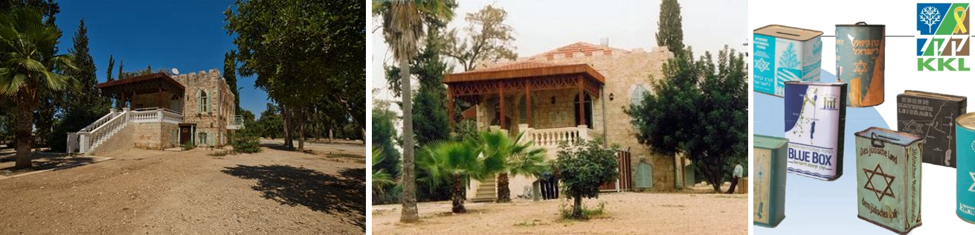
Nearly four thousand years later, the Jewish people renewed this act. On December 29, 1901, in Basel, the Fifth Zionist Congress founded the Keren Kayemeth LeIsrael (KKL), the Jewish National Fund, to acquire land in the Land of Israel on behalf of the Jewish people [3]. In homes all over the world, the “Blue Box” collected the coins [4].
In 1904, the KKL redeemed at Hulda, near Rehovot, its first land bought from non-Jewish owners [5]. Herzl died that same year. Four years later, an olive grove was planted there in his memory. In 1909, a large house rose among the trees: Herzl House [6]. In 1912, the KKL planted its first pine forest there, and the farm trained pioneers in agriculture and forestry.
In 1929, Ephraim Chizik fell defending the house [7]. Restored for the State’s fiftieth anniversary, it reopened in 2023 as “Herzl Farm.”
[1] The names Avraham (אברהם) and Efron (עפרון) share only one letter, the ר, placed at the center of each, “between me and you.” The ר is worth 200, and the two letters together make 400. In the next verse (23:16), Efron’s name loses its vav and is spelled עפרן. According to the Baal HaTurim, it is then worth 400, like עין רע, “the evil eye.”
[2] According to Bereshit Rabbah (79:7), there are three places of which the nations can never say “you stole them,” because they were paid for in full: the Cave of Machpelah, bought by Avraham (Genesis 23:16), the Temple Mount, bought by David (I Chronicles 21:25), and Joseph’s Tomb in Shechem, bought by Yaakov (Genesis 33:19).
[3] The idea came from the mathematician Hermann Zvi Schapira, who had proposed it at the First Congress in 1897.
[4] Conceived by Chaim Kleinman, a bank clerk in Galicia, it was spread by Yona Kremenetzky, the Fund’s first president.
[5] The KKL’s very first purchase was Kfar Hittim, in the Lower Galilee, but that land was already in Jewish hands. Hulda was its “first act of redemption.” Kibbutz Hulda’s own history dates it to 1905. As the Fund did not yet have legal status, the land was registered in the name of David Zalman Levontin.
[6] It was built for the agronomist Louis Barish, the farm’s first director. His successor, Yitzhak Vilkansky, turned it into a training farm.
[7] Having come from the Galilee to help the defenders, Ephraim Chizik sheltered them in the house and led the defense, before being shot dead. A monument to the fallen pioneers, “Labor and Defense,” sculpted by Batya Lichansky, was unveiled on the site in 1937.