Matot–Massé (מַטּוֹת–מַסְעֵי — Tribes – Journeys)
Numbers 30:2–36:13 • Irmyahou (Jeremiah) 2:4–28; 3:4
Matot deals with vows, then with the war against Madyan and the division of the territories located east of the Jordan. Massé recounts the forty‑two stages of the wilderness journey, sets the boundaries of Canaan, establishes the cities of refuge, and concludes with the inheritance of the daughters of Tselof’had. In the haftara[1], the prophet Irmyahu calls Israel to return to God and denounces the breach of the Covenant that has weakened the people.
Numbers 31:2[2]
נְקֹם נִקְמַת בְּנֵי־יִשְׂרָאֵל מֵאֵת הַמִּדְיָנִים
“Carry out the vengeance of the children of Israel upon the Madyanites.”
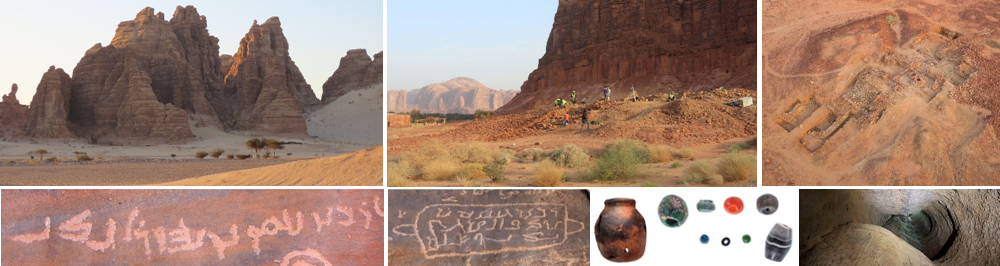
Ancient sources[3] place the territory of the Madyanites in the northwest of present‑day Saudi Arabia, around the Wadi al‑Qurā (Valley of the Villages). It was in the heart of this region that, in 2019, Franco‑Saudi excavations[4] uncovered, in the city of Al‑‘Ula (The Sublime), a settlement occupied between the 3rd and 7th centuries CE. Domestic refuse pits yielded sheep and goat bones, but no camel remains[5], despite the animal’s omnipresence in the region. Nabatæan inscriptions bearing Jewish names[6] corroborate the existence of a Jewish community established in this valley. The site was abandoned at the beginning of the 7th century, but a new settlement was immediately built nearby. Medieval Hebrew inscriptions — distinct from the earlier Nabatæan inscriptions — attest to a Jewish presence[7] still documented there until the 10th century.
[1] The haftara belongs to the cycle of tlata de‑puranuta (תלתא דפורענותא), an Aramaic expression meaning “the three admonitions.” This cycle designates the three haftarot read on the three Sabbaths preceding Tisha be‑Av (Irmyahu 1–2; Irmyahu 2–3; Yeshayahu 1), independently of the content of the parasha.
[2] נִקְמַת בְּנֵי־יִשְׂרָאֵל (nikmat bene Israel), “the vengeance of the children of Israel.” In the following verse (Numbers 31:3), when Moshe conveys this command to the people, the expression becomes נִקְמַת־ה׳ (nikmat Hashem), “the vengeance of the Eternal.” Rashi explains this shift: whoever attacks Israel attacks the Holy One, blessed be He; the vengeance of Israel and that of God are therefore inseparable.
[3] Madyan is identified in Jewish sources — Onkelos (Targum, 2nd century) and Flavius Josephus (Jewish Antiquities, 1st century) — in Greek sources — Ptolemy (Geography, 2nd century) and Strabo (Geography, 1st century BCE) — as well as in medieval Arabic sources — al‑Ya‘qūbī (Kitāb al‑Buldan – Book of the Lands, 9th century), al‑Muqaddasī (Aḥsan al‑Taqāsīm – The Best Division of the Provinces, 10th century), and Yāqūt al‑Ḥamawī (Mu‘jam al‑Buldan – Dictionary of Places, 13th century). All locate Madyan in the northwest of Arabia, around Tabūk, the Gulf of Aqaba, and the Wadi al‑Qurā — corresponding to the present‑day region of Al‑‘Ula.
[4] Excavations conducted by archaeologists Jérôme Rohmer (France) and Abdulrahman Alsuhaibani (Saudi Arabia), in collaboration with teams from the CNRS (French National Centre for Scientific Research), AFALULA (French Agency for the Development of Al‑‘Ula), and the RCU (Royal Commission for AlUla). The results were published in Arabian Archaeology and Epigraphy, 2025.
[5] The dromedary and the camel are classified among impure animals (Leviticus 11:4; Deuteronomy 14:7). Their presence in the region is massive from antiquity onward, but their absence from the refuse pits of Al‑‘Ula suggests dietary practices consistent with biblical prescriptions.
[6] The Nabatæan inscriptions discovered on ostraca and architectural blocks — written from right to left — bear Jewish anthroponyms such as ʾnny bn ywsf (ענני בן יוסף, Anani ben Yosef) or nhmy bn ydy (נחמי בן ידי, Neḥami ben Yadi), corroborating other evidence of a Jewish community established in the valley of the Wadi al‑Qurā.
[7] Medieval Arabic geographers — notably al‑Ya‘qūbī — preserve the memory of an ancient Jewish presence in the region of the Wadi al‑Qurā. Medieval Hebrew inscriptions, found at a nearby site in Al‑‘Ula and distinct from the earlier Nabatæan inscriptions, attest to a Jewish presence in this region until the 10th century.