Pinchas (פִּינְחָס)
Numbers 25:10–30:1 • 1 Kings 18:46–19:21
The parasha recounts how Pinchas acts with a zeal that earns him the covenant of an everlasting priesthood, passed down to his descendants, while the haftarah shows Elijah, exhausted yet likewise filled with fervent zeal, receiving from God the strength to continue his mission and appoint Elisha as his successor.
1 Kings 19:16
… וְאֶת־אֱלִישָׁע בֶּן־שָׁפָט מֵאָבֵל מְחוֹלָה, תִּמְשַׁח לְנָבִיא תַּחְתֶּיךָ.
“And Elisha son of Shaphat, from Avel‑Meholah, you shall anoint as prophet in your stead.”
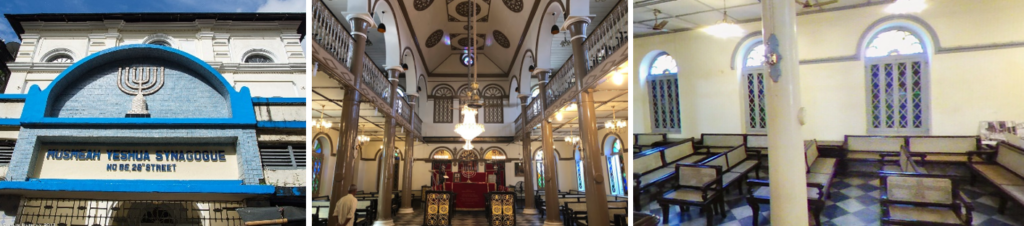
In 1978, Isaac Samuels, guardian of the Musmeah Yeshua Synagogue (משמיע ישועה – “He Who Makes Salvation Heard”), in the heart of old Rangoon (Yangon), in Burma (Myanmar), entrusted his son Moses with the responsibility of watching over the synagogue and made him promise never to abandon it. Moses kept this promise, and upon his death in 2015, his son Sammy naturally assumed the stewardship of the place [1], together with his sisters Dina and Kaznah.
It is the only synagogue[2] in the country , inaugurated in 1896. Its style blends British colonial architecture with Sephardi tradition, featuring rattan benches suited to the tropical climate and a dome painted in blue and white. It once served a prosperous Jewish community [3], which owned 126 Torah scrolls, of which only two remain today.
Following the Japanese invasion, and later with the establishment of the military regime [4], the community gradually dispersed, family by family, until only about twenty Jews remain in the country today.
[1] Testimonies from the Samuels family, collected in reports devoted to the Musmeah Yeshua Synagogue (notably Jerusalem Post and Haaretz, as well as the Jewish Telegraphic Agency (JTA) dispatch of April 29, 2015 announcing the death of Moses Samuels). The story is also documented in the film The Last Synagogue of Yangon, directed by Maya Ben‑Dor, and in the work of Ruth Levy, historian of Jewish communities in Southeast Asia, and Graham Harvey, British anthropologist specializing in religious minorities.
[2] An earlier wooden synagogue was built in 1854.
[3] The Jewish community of Burma numbered around 2,500 people in 1940, making it one of the largest in Southeast Asia. It consisted mainly of Baghdadi Jews who had arrived from Iraq in the 18th–19th centuries and settled in Calcutta and Bombay, along with several Bene Israel families — a very old community from the Konkan coast (Bombay), combining Middle Eastern Jewish and Indian ancestry — as well as Jews from Cochin, established since the 15th century in Kerala, bearers of Sephardi and Yemenite traditions.
[4] The Japanese invasion of 1942 led to the evacuation of most of Rangoon’s Jews to British India. Later, the establishment of the military regime in 1962 brought political and economic isolation that accelerated the exodus of the Jewish community and other minorities. The country remains today under the authority of a military junta, the result of yet another coup d’État (2021), maintaining an authoritarian regime and strict control over political life.