Hukat [1] (חֻקַּת — divine law without explicit reason)
Numbers 19:1–22:1 • Judges 11:1–33
The portion opens with the red heifer, then recounts the deaths of Miriam and Aaron, and Moses’s sin at the rock. The haftarah tells the story of Jephthah, illegitimate son, driven out by his brothers, who took refuge in the land of Tob before being recalled by the elders of Gilead.
Judges 11:2
ויגרשו אתיפתח ויאמרו לו לאיתנחל בביתאבינו כי בןאשה אחרת אתה
“They drove out Jephthah and said to him: you shall have no inheritance in our father’s house, for you are the son of another woman.”
Born in 1927, William Wolff was driven out of Germany in 1933 by the rise of
Nazism; his family settled in London in 1939. He became a journalist, and then, in
1984, a rabbi — at the age of fifty-seven. In 2002, he was called to Schwerin as
Landesrabbiner [2] . In 2014, he received honorary citizenship of the city.
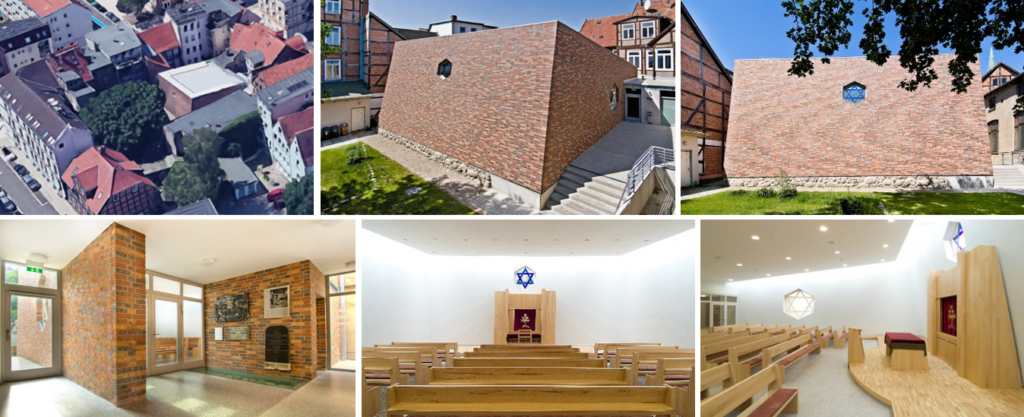
The synagogue of the Jüdische Gemeinde of Schwerin, built on the site of the two
synagogues destroyed in 1938, was realised at the initiative of the Jewish
community with the support of the Land [3] . Constructed in 2008 by the architects
Joachim and Matthias Brenncke [4] , it presents itself as a contemporary volume in
dark red brick, crowned by a sloping roof that opens into a skylight toward the
heavens. Excavations revealed the foundations and paving stones of 1819, now
integrated into the new building.
[1] In the diaspora, the portion read this week is Korah.
[2] The Landesrabbiner — state rabbi — is the official representative of the Jewish
community before the authorities of the Land. The post, which had existed in
Mecklenburg since the nineteenth century, had remained vacant throughout the Nazi
and Communist periods. Wolff became its first holder in more than sixty years.
[3] The financial support of the Land of Mecklenburg-Vorpommern is part of the
German policy of support for Jewish life and acknowledgment of local history, following the destruction of 1938 and the absence of reconstruction during the
Communist period.
[4] Joachim and Matthias Brenncke, architects in Schwerin, partners of the firm
Brenncke Architekten.