Emor – אֱמֹר — “Speak”
Leviticus 21–24 • Ezekiel 44:15–31
God instructs Aaron and his sons to transmit and to bless. The priestly charge is not a privilege; it is a task. Their role is to convey the meaning of the sacred. Ezekiel reminds us that even in exile, the Cohanim have a concrete responsibility: to transmit the laws of holiness and purity and to bless Israel.
Ezekiel 44:23
וְאֶת־עַמִּי יוֹרוּ בֵּין קֹדֶשׁ לְחֹל וּבֵין־טָמֵא לְטָהוֹר יוֹדִעֻם
“They shall teach My people to distinguish between the sacred and the profane, and make known to them the difference between what is impure and what is pure.”
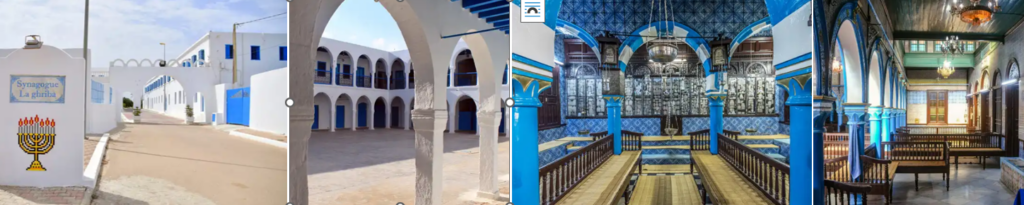
According to local tradition, Cohanim fleeing the destruction of the First Temple are said to have settled in Hara Sghira[1], on the island of Djerba. On the edge of this quarter stands the El Ghriba Synagogue[2], an ancient place of worship that has become a major center of Jewish pilgrimage. Each year, during the month of Iyar[3], worshippers gather there for prayer and celebration, drawing pilgrims from Tunisia, Libya, Egypt, and Europe.
The building, reconstructed several times over the centuries, retains a solid architectural presence: whitewashed walls punctuated by deep blue painted arches. The geometric tilework and carved wooden elements, characteristic of Djerban aesthetics, lend the space a subdued, restrained atmosphere conducive to contemplation and reflection (click). Since 2023, the El Ghriba Synagogue—together with the island of Djerba as a whole—has been inscribed on the UNESCO World Heritage List.
[1] Hara Sghira (“the small quarter”) is one of the two historic Jewish quarters of Djerba, alongside Hara Kbira (“the large quarter”). According to local tradition, it was the first site of Jewish settlement on the island and was long inhabited predominantly by Cohanim.
[2] The Arabic term ghriba means “strange,” “singular,” or “set apart.” It refers to that which is separated from common use—a meaning that resonates with the biblical notion of kadosh (holy). According to one tradition, a young woman living in seclusion, referred to as the ghriba (“the stranger”), died in a fire, yet her body was found intact—an event interpreted as a sign of sanctity. An older tradition recounts that Cohanim brought an element of the First Temple of Jerusalem and incorporated it into a sanctuary known as the Ghriba, a term designating a place set apart and consecrated.
[3] The 14th of Iyar corresponds to Pesach Sheni, instituted for those who were unable to offer the Paschal sacrifice at its appointed time (Numbers 9:6–13). This date is also associated with the hiloula (anniversary of passing) of Rabbi Meir Baal HaNess, a second‑century sage.
The 18th of Iyar (Lag BaOmer) marks the end of a period of mourning linked to the death of Rabbi Akiva’s 24,000 students. It is also associated with the hiloula of Rabbi Shimon bar Yochai, master of mystical tradition and central figure of the Zohar. A day of joy, it represents the culmination of the El Ghriba pilgrimage in Djerba.