Vayaqhel–Pekudei – Shabbat HaChodesh
ויקהל–פקודי – שבת החודש
“And he assembled” / “Inventory” – Shabbat of the New Month
Exodus 35:1–40:38 — HaChodesh: Exodus 12:1–20 — Ezekiel 45:16–46:18
The portions Vayaqhel–Pekudei recount the completion of the Mishkan, constructed under the direction of Bezalel and Oholiav. Associated with these readings, that of Shabbat HaChodesh introduces the month of Nisan. The corresponding haftarah describes the regulations concerning the future Temple.
Exodus 12:2
הַחֹדֶשׁ הַזֶּה לָכֶם רֹאשׁ חֳדָשִׁים
This month shall be for you the beginning of months.
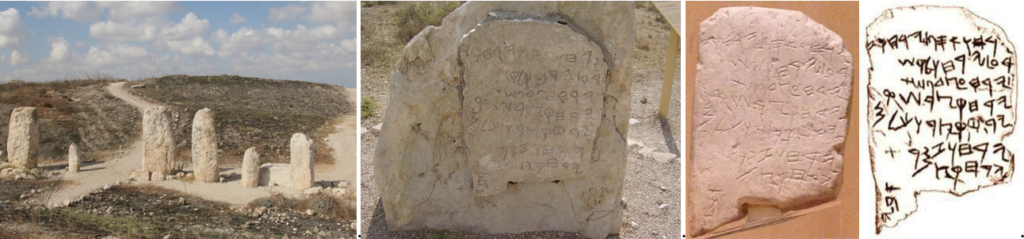
Discovered in 1908 at the site of Tel Gezer, between Jerusalem and the coastal plain, the Gezer Calendar is a small limestone tablet inscribed in Proto‑Canaanite or Paleo‑Hebrew script, unearthed by R. A. S. Macalister[1]. It is traditionally dated to the 10th century BCE and is among the earliest known examples of Hebrew writing[2]. The original is housed in the Istanbul Archaeological Museum, and a copy is displayed at the Israel Museum in Jerusalem.
The Hebrew calendar is based on a lunisolar system. The year consists of twelve months, to which a thirteenth is added in leap years (seven years within a nineteen‑year solar cycle). The months follow the lunar cycle and contain either 29 or 30 days[3]. The month of Nisan (March/April) marks the beginning of the religious year. The month of Tishri (September/October) is the first month of the civil year. Since the 4th century, the calendar has been based on a fixed calculation attributed to Hillel II[4], ending the monthly proclamation that relied on observing the new moon.
[1] Robert Alexander Stewart Macalister (1870–1950), Irish archaeologist, directed the excavations at Gezer from 1902 to 1909, one of the first large‑scale scientific archaeological digs.
[2] The Paleo‑Hebrew alphabet is a local development of Proto‑Canaanite, used in the kingdoms of Israel and Judah until the Babylonian exile. From the 6th century BCE onward, it was gradually replaced by the square script (Imperial Aramaic), which became the standard Hebrew alphabet in rabbinic tradition.
[3] For months of thirty days, Rosh Chodesh extends over two days. The mean lunar cycle is calculated at 765,433 halakim (29 days = 751,680 halakim; 12 hours = 12,960 halakim; and 44 minutes and 3⅓ seconds = 793 halakim).
[4] Hillel II (c. 320–385), the last Nasi of a still‑functioning Sanhedrin, instituted a calculated calendar to ensure uniform festival dates throughout the Jewish diaspora. This reform ended the monthly proclamation based on observing the lunar crescent.