Bamidbar (במדבר / Ba‑Midbar, “In the Desert”)
Numbers 1:1–4:20 • Hosea 2:1–22 • Pirkei Avot, chap. 6 (Perek Kinyan Torah [1])
In the desert, Moses conducts the census of Israel, organizes the placement of the tribes around the sanctuary, and entrusts the Levites with their responsibilities. The desert is not only a place of passage: it becomes the space where the people are structured and receive a collective mission. The prophet Hosea evokes the desert as a place of return and of rediscovered speech. It is in this stripped‑down space that a bond can be repaired.
Hosea 2:16 [2]
לָכֵן הִנֵּה אָנֹכִי מְפַתֶּיהָ וְהֹלַכְתִּיהָ הַמִּדְבָּר וְדִבַּרְתִּי עַל־לִבָּהּ
“Therefore, here I am: I will allure her, I will lead her into the desert, and I will speak to her heart.”
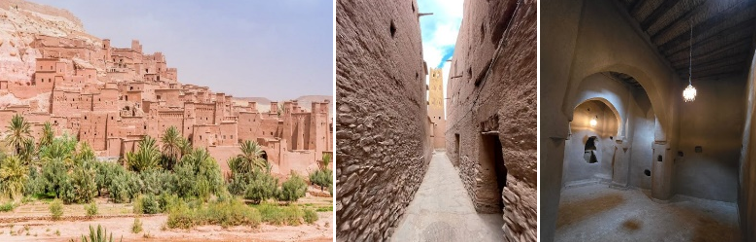
At the entrance to the desert, in the ksar of Amezrou, near Zagora, this fortified village—historically linked to Saharan caravan routes [3]—once housed a rural and oasis‑dwelling Jewish community of southern Morocco, belonging to what can be described as Judeo‑Berber Judaism [4].
Throughout the Drâa Valley, silversmithing and jewelry‑making [5], practiced notably by Jewish artisans, were traditional local activities.
In the early 1960s, the Jews gradually left Amezrou for Israel, in the context of post‑independence Morocco. The departure of the last families took place around 1962–1963.
The Amezrou synagogue, built of rammed earth (pisé), still stands today at the heart of the ksar, in the former mellah. Its Aron ha‑Kodesh is carved into the eastern wall, and its roof rests on palm‑tree beams, following traditional techniques.
[1] Kinyan Torah (קניין תורה), “acquisition of the Torah,” is the traditional name given to chapter 6 of Pirkei Avot. This chapter emphasizes the value of Torah study and the dispositions through which it is acquired, notably the list of the forty‑eight ways of acquiring the Torah.
[2] Use of the feminine: Hosea uses the image of the wife to express the relationship between God and Israel.
[3] Historical context: The ksar of Amezrou is part of the system of fortified villages of southern Morocco, developed along Saharan caravan routes. These structures shaped settlement, trade, and communal life among oasis populations—Muslim and Jewish—in the Drâa Valley.
[4] The expression Judeo‑Berber refers to the diversity of Jewish communities of the Maghreb who lived in Berber‑speaking environments.
[5] Silversmithing and jewelry‑making are attested as traditional activities of the Drâa Valley, historically associated with the Jewish presence in the region’s ksour.