Shemini Atzeret
(שמיני עצרת – Eighth Day of Assembly)
Simchat Torah
(שמחת תורה – Rejoicing with the Torah)
Deuteronomy 33:1-34:12 • Genesis 1:1-2:3 • Numbers 29:35-30:1 • Joshua 1:1-18¹
Vezot Haberakhah brings the Torah to its conclusion: Moses blesses the tribes before his death on Mount Nebo, and the reading immediately begins again with the opening verse of Bereshit. In the haftarah, God entrusts Joshua with leading the people into the Promised Land and commands him to meditate upon the Torah day and night.
Deuteronomy 33:4
תּוֹרָה צִוָּה־לָנוּ מֹשֶׁה מוֹרָשָׁה קְהִלַּת יַעֲקֹב
« The Torah that Moses commanded us is the inheritance of the congregation of Jacob. »
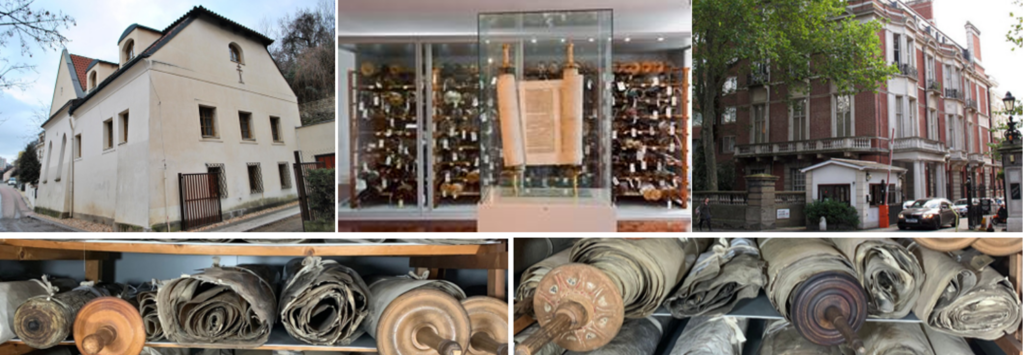
In 1942, under the control of the Nazi authorities of the Protectorate of Bohemia and Moravia, members of Prague’s Jewish community, at the initiative of Karel Stein², obtained permission to gather the religious treasures of the country’s devastated synagogues in the Central Jewish Museum³. Approximately 1,800 Torah scrolls were catalogued there, each identified by its place of origin. From 1956 to 1959, the scrolls were assembled in the former Michle Synagogue⁴ on the outskirts of Prague.
In 1963, the Czechoslovak State, through Artia⁵, offered the scrolls for sale to the London art dealer Eric Estorick⁶. He informed Ralph Yablon⁷, who agreed to finance the purchase after the scrolls had been examined in Prague by Chimen Abramsky⁸ and approved by Rabbi Harold Reinhart⁹ of Westminster Synagogue.
On 7 February 1964, two trucks unloaded 1,564 of these scrolls at Kent House¹⁰ for the benefit of the Memorial Scrolls Trust¹¹.
Sofrim examined the scrolls and restored them whenever possible. The Memorial Scrolls Trust loans them to synagogues, schools, and museums. Scrolls that are kosher are used for public Torah reading; the others serve educational and commemorative purposes. Any institution that closes or merges must return its scroll. Today, these scrolls are found in more than 1,300 communities and institutions, from Alaska to New Zealand.
¹ In the Diaspora, Shemini Atzeret has its own readings: Deuteronomy 14:22-16:17 (15:19-16:17 on weekdays) • Numbers 29:35-30:1 • I Kings 8:54-9:1. Simchat Torah is celebrated on the following day.
² Karel Stein (1906-1961), head of the Rural Affairs Department of Prague’s Jewish Community. He survived the war and resumed his work at the museum.
³ Among the museum staff, Chief Curator Josef Polák (1886-1945), an art historian active in the Resistance, was arrested by the Gestapo in August 1944 and disappeared at Auschwitz in January 1945. Rabbi and librarian Tobias Jakobovits (1887-1944) and architect František Zelenka were deported to Auschwitz in the autumn of 1944 and perished there. Art historian Hana Volavková (1904-1985) survived and reopened the museum on 13 May 1945.
⁴ After the war, the museum lent scrolls to the re-established Jewish communities of Bohemia, Moravia, and Slovakia. Many were later returned when a number of those communities disappeared under the Communist regime.
⁵ Artia was a Czechoslovak state enterprise based in Prague that held the monopoly on the foreign trade of cultural property from 1953 until its dissolution in 1990. Since the museum had been nationalised in 1950, the scrolls were state property and could be sold in exchange for the foreign currency needed by the regime.
⁶ Eric Estorick (1913-1993), born Elihu Estorick in Brooklyn to Jewish immigrants from Russia, directed the Grosvenor Gallery and frequently travelled to Prague to acquire works of art. He was seeking a Torah scroll for his father when Artia brought him to Michle.
⁷ Ralph Yablon (1906-1984), a lawyer who became a businessman and philanthropist, was a founding member of Westminster Synagogue and contributed to the purchase of Kent House. He remained a trustee of the Trust until his death.
⁸ Chimen Abramsky (1916-2010), historian and bibliographer, was a specialist in ancient Hebrew books and manuscripts, long associated with Sotheby’s before becoming Professor of Jewish Studies at University College London. He was the son of Rabbi Yehezkel Abramsky, author of Hazon Yehezkel and a dayan of the London Beth Din.
⁹ Harold Reinhart (1891-1969) served as rabbi of Westminster Synagogue from 1957 to 1969.
¹⁰ Kent House was acquired by the congregation in 1960. The Trust Museum, located on the third floor, may be visited by appointment.
¹¹ Each scroll bears a numbered brass plaque from 1 to 1,564. The Trust also preserves its original Prague inventory number, making it possible to identify its town of origin. In 2017, a scroll originating from Olomouc (Moravia) was returned to the city’s revived Jewish community. A non-kosher scroll is now displayed in the Czech Parliament. The full story is told by Philippa Bernard in Out of the Midst of the Fire.