Bereishit: Shabbat Machar Chodesh
(בראשית – שבת מחר חודש – “In the Beginning” – tomorrow is the New Moon)
Bereishit 1:1-6:8; I Samuel 20:18-42
God creates the world in six days, then ceases His work and sanctifies the seventh day. He places the man and the woman in the Garden of Eden, from which they are expelled after eating from the Tree of Knowledge. The narrative then recounts Cain’s murder of Abel, the ten generations separating Adam from Noah, and the growing corruption of humanity, amidst which Noah alone finds favor in the eyes of God.
Bereishit 2:13
וְשֵׁם־הַנָּהָר הַשֵּׁנִי גִּיחוֹן הוּא הַסּוֹבֵב אֵת כׇּל־אֶרֶץ כּוּשׁ
“The name of the second river is Gihon; it is the one that encircles the entire land of Cush.”
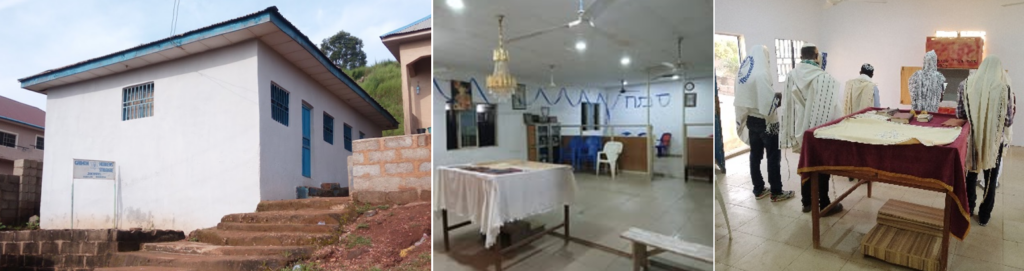
In Jikwoyi, a suburb of Abuja, the federal capital of Nigeria, stands Gihon Synagogue[1] a modest building located beside an unpaved road among homes and small shops. The community was founded during the 1990s by Igbo[2] Jews who had come from southeastern Nigeria. The land was purchased around 2002 through a community fundraising effort, and the building was completed in 2005. The prayer hall is a simple rectangular structure measuring approximately 7 by 12 meters.
Every Shabbat, several dozen worshippers gather there for prayer services and Torah reading, following practices largely inspired by the traditions of Edot HaMizrach[3]. During Sukkot, a sukkah made of palm fronds is erected outside (La Nación, Argentina, November 2021). Gihon Synagogue is often described as the principal Igbo synagogue in Abuja[4]. Some members of the congregation identify with the tradition that regards Eri[5] as the ancestor of the Igbo people.
In 2013, the community was led by Elder[6] Ovadia Agbai, a retired geologist who had assumed leadership in 2006, while its spokesman was Pinchas Ogbukaa. Both men were invited[7] to Providence, Rhode Island, for Sukkot and Simḥat Torah by Beth Sholom Synagogue (Modern Orthodox) and Temple Emanu-El (Conservative). They also visited several other Jewish institutions, including Touro Synagogue in Newport, the oldest synagogue in the United States. As a result of this visit, Kulanu[8] incorporated the Igbo Jewish communities of Abuja into its international network.
Despite these developments, the community remains relatively isolated from mainstream institutional Judaism. Although its members claim Israelite ancestry, this is not accepted by the Chief Rabbinate as proof of Jewish status according to halakhic standards. Consequently, a conversion recognized under halakhah is generally required.
[1] (גִּיחוֹן) is the second of the four rivers flowing out of the Garden of Eden (Genesis 2:10-14).
• The first, Pishon (פִּישׁוֹן), remains of uncertain identification. In Antiquities of the Jews (I, 1, 3), Flavius Josephus identifies it with the Ganges.
• Gihon is traditionally identified with the Nile, notably by Flavius Josephus and Saadia Gaon. According to Genesis 2:13, it “encircles the whole land of Cush.” In classical Jewish tradition, Cush generally refers to the regions south of Egypt, namely Nubia and Ethiopia. This association has led Gihon to be viewed as the river most closely connected with Africa among the four rivers of Eden.
• Hiddekel (חִדֶּקֶל) is universally identified with the Tigris.
• Perat (פְּרָת) corresponds to the Euphrates.
[2] The Igbo are one of Nigeria’s major ethnic groups, native to the country’s southeastern region, numbering in the tens of millions. They are overwhelmingly Christian. Some assert Israelite ancestry, but only a small minority, estimated at several thousand individuals, practice Judaism.
[3] Edot HaMizrach (עֲדוֹת הַמִּזְרָח, “Communities of the East”) refers to the liturgical traditions of Jewish communities from the Middle East and Arab countries, which have strongly influenced contemporary Igbo Jewish communities.
[4] In 2013, Abuja had three or four Igbo synagogues. The others were Tikvat Israel, led by Habakkuk Nwafor; Plant for the Growth of Israel, led by Remy Ilona; and Igbo Israel Heritage, led by Michael Caliben.
[5] Bereishit 46:16: Eri was one of the sons of Gad. Certain Igbo traditions regard Eri as the forefather of their people and speak of an ancient migration from the Near East and the Nile Valley. In support of this tradition, community members point to practices such as circumcision on the eighth day and the observance of the new moon.
[6] Elder is an honorary title bestowed upon community leaders, reflecting the wisdom and authority associated with age.
[7] Providence visit, September 2013. The purpose was to reduce the isolation of Igbo Jewish communities and to observe the functioning of an established Jewish congregation.
[8] Kulanu is an American organization that supports isolated and emerging Jewish communities around the world.