Devarim (דְּבָרִים — Words)
Shabbat Chazon (שַׁבָּת חֲזוֹן – Shabbat of the Vision)
Deut. 1:1–3:22 • Isaiah 1:1–27
Before entering Canaan, Moses recounts Israel’s journey through the desert and transmits the Torah to the new generation. In the haftarah, Isaiah opens his book with a vision in which God denounces the sins of Jerusalem and announces the judgment that threatens it — a prelude to purification and renewal.
Deut. 1:5
הוֹאִיל מֹשֶׁה בֵּאֵר אֶת הַתּוֹרָה הַזֹּאת
“Moses set out to explain this Torah.”
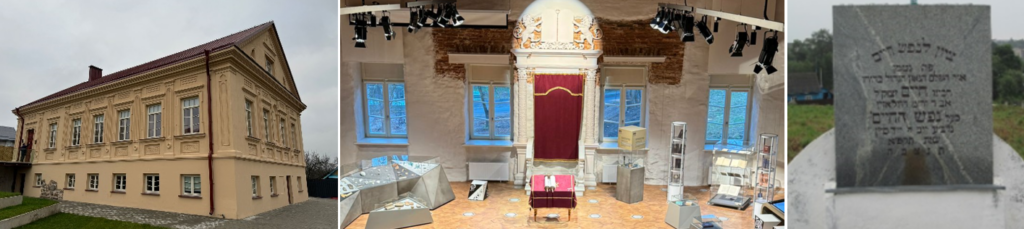
To explain the Torah, to make it intelligible: this is also the aim of Rabbi Chaim of Volozhin[1] when he founded the Etz Chaim yeshiva[2] in 1803. He developed a method of study that emphasizes the plain meaning (peshat)[3] of the text and its rigorous analysis.
In the 1880s–1890s, Tsar Alexander III imposed a policy of Russification and new state‑imposed requirements for the curriculum[4]. Rabbi Naftali Tzvi Yehuda Berlin[5], then head of the yeshiva, refused to comply. After nearly a century of activity, the institution closed in 1892. It reopened in 1899 on a smaller scale and continued operating until the destruction of the Jewish community[6] by Nazi Germany during the Shoah.
Returned to the Jewish community in 1989 and entrusted in 2000 to the Union of Religious Jewish Communities of Belarus, the building was restored beginning in 2008 thanks to support from several organizations[7]. Now open as a museum dedicated to the memory of Litvak (Lithuanian) Jewry, it is part of the Belarus Jewish Heritage Trail, a heritage route highlighting major Jewish memory sites in the country.
[1] Rabbi Chaim ben Yitzchak of Volozhin (1749–1821) studied under the Shaagas Aryeh and then under Raphael ha‑Kohen Hamburger (1722–1803), chief rabbi of Vilna. At twenty‑five, he became the principal disciple of the Vilna Gaon (1720–1797), whom he accompanied until his death. His major work, Nefesh ha‑Chaim, presents a structured theology of Torah, prayer, and the fear of God.
[2] When the yeshiva opened, Rabbi Chaim supported about ten students from his own funds. In 1804, he launched an appeal for donations to help the school grow. Within twenty years, enrollment rose from a handful to several hundred students, and the institution became the “mother of Lithuanian yeshivot,” a model for Mir, Slobodka, Telz, Kelm, and Ponevezh.
[3] Peshat, the plain meaning, is the first of the four traditional levels of interpretation, along with remez (allusion), derash (homiletical reading), and sod (hidden dimension). This initial focus on peshat characterizes the Volozhin method, which prioritizes analytical study of the text before homiletical or mystical readings.
[4] In 1891, Minister of Education Ivan Delyanov imposed new conditions on the curriculum: secular studies had to take place from 9 a.m. to 3 p.m., teachers had to hold state diplomas, and nighttime study in the yeshiva was forbidden. These measures effectively eliminated the time available for religious study.
[5] Rabbi Naftali Tzvi Yehuda Berlin (1816–1893), known as the Netziv (נצי״ב), led the Volozhin yeshiva during the second half of the 19th century. He married Rayna Batya Volozhiner, granddaughter of Rabbi Chaim of Volozhin. His leadership left a lasting mark on the institution, and Rabbi Avraham Yitzchak ha‑Cohen Kook, a student in Volozhin in the 1880s, acknowledged the decisive influence of the Netziv on his formation.
[6] Before the war, about half of Volozhin’s population was Jewish — nearly 3,000 people on the eve of the Shoah. During the German occupation in 1941, a ghetto was established, followed by mass executions and the near‑total liquidation of the community in 1942.
[7] World Monuments Fund (WMF): an international organization based in New York specializing in the preservation of endangered historic sites. Yad Yisroel: an Orthodox Jewish organization active in Eastern Europe, particularly Belarus and Ukraine. Agudath Israel: an American Orthodox Jewish organization involved in education and community support. The Union of Religious Jewish Communities of Belarus (URJCB) is the official body managing synagogues, memorial sites, and Jewish religious institutions in Belarus.